Ch.21 - Nuclear Chemistry
Brown - Chemistry: The Central Science 15th Edition
Brown15th EditionChemistry: The Central ScienceISBN: 9780137542970Non è quello che usi tu?Cambia libro di testo
Capitolo 21, Problema 7b

All the stable isotopes of boron, carbon, nitrogen, oxygen, and fluorine are shown in the accompanying chart (in red), along with their radioactive isotopes with t1>2 7 1 min (in blue). (b) Which radioactive isotopes are most likely to decay by beta emission? [Sections 21.2, 21.4, and 21.5]
Chart showing stable and radioactive isotopes of boron to fluorine by protons and neutrons.

Guida verificata passo dopo passo
1
Identify the radioactive isotopes from the chart (highlighted in yellow).
Recall that beta emission occurs when a neutron is converted into a proton, emitting a beta particle (electron) and an antineutrino.
Determine which isotopes have a neutron-to-proton ratio that is higher than the stable isotopes, as these are more likely to undergo beta emission to achieve stability.
Compare the neutron-to-proton ratios of the radioactive isotopes with those of the stable isotopes.
Select the radioactive isotopes with higher neutron-to-proton ratios as the ones most likely to decay by beta emission.

Risposta video verificata per un problema simile:

Questa soluzione video è stata consigliata dai nostri tutor come utile per risolvere questo problema.
Durata del video:
5m

Concetti chiave

Ecco i concetti essenziali che devi comprendere per rispondere correttamente alla domanda.

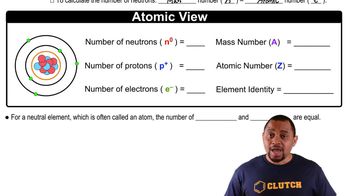
Isotopes

Isotopes are variants of a particular chemical element that have the same number of protons but different numbers of neutrons. This difference in neutron count results in varying atomic masses. Stable isotopes do not undergo radioactive decay, while unstable isotopes are radioactive and can decay into other elements or isotopes over time.
Video consigliato:

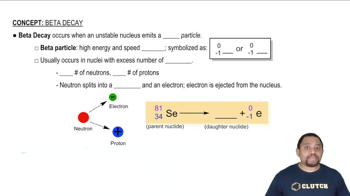
Beta Emission

Beta emission is a type of radioactive decay in which a beta particle (an electron or positron) is emitted from an atomic nucleus. This process occurs when a neutron is transformed into a proton, increasing the atomic number of the element while keeping the mass number constant. It is a common decay mode for isotopes that are neutron-rich.
Video consigliato:

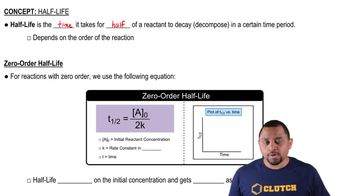
Half-Life

Half-life is the time required for half of the radioactive nuclei in a sample to decay. It is a crucial concept in understanding the stability and decay rates of isotopes. The half-lives of isotopes can vary widely, from fractions of a second to thousands of years, influencing their applications in fields such as medicine and archaeology.
Video consigliato:
Percorso guidato
02:17
Zero-Order Half-life