Ch.21 - Nuclear Chemistry
Brown - Chemistry: The Central Science 15th Edition
Brown15th EditionChemistry: The Central ScienceISBN: 9780137542970Non è quello che usi tu?Cambia libro di testo
Capitolo 21, Problema 12c

Give the symbol for (c) a positron.

Guida verificata passo dopo passo
1
Understand that a positron is a subatomic particle with the same mass as an electron but with a positive charge.
Recall that the symbol for an electron is \( e^- \).
Since a positron is the antimatter counterpart of an electron, it has the same symbol but with a positive charge.
The symbol for a positron is \( e^+ \).
Alternatively, a positron can also be represented as \( \beta^+ \), indicating it is a type of beta particle with a positive charge.

Risposta video verificata per un problema simile:

Questa soluzione video è stata consigliata dai nostri tutor come utile per risolvere questo problema.
Durata del video:
1m

Concetti chiave

Ecco i concetti essenziali che devi comprendere per rispondere correttamente alla domanda.

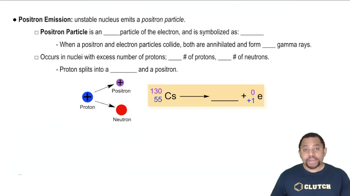
Positron

A positron is the antiparticle of the electron, possessing the same mass as an electron but a positive charge. It is represented by the symbol 'e⁺'. When a positron encounters an electron, they can annihilate each other, producing gamma-ray photons, which is a key process in particle physics and applications like positron emission tomography (PET) in medical imaging.
Video consigliato:
Percorso guidato
01:53
Positron Emission

Antimatter

Antimatter consists of particles that have the same mass as their corresponding matter particles but opposite charges. For example, the positron is the antimatter counterpart of the electron. The study of antimatter is crucial in understanding fundamental symmetries in physics and has implications for theories about the universe's composition and the behavior of particles at high energies.

Particle Physics

Particle physics is the branch of physics that studies the fundamental constituents of matter and radiation, and their interactions. It involves understanding particles like electrons, positrons, quarks, and bosons, and the forces that govern their behavior. This field is essential for exploring the fundamental laws of nature and has led to significant discoveries, including the Higgs boson.
Video consigliato:
Percorso guidato
05:19
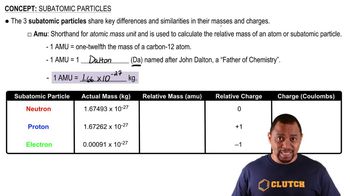
Subatomic Particles