Ch.21 - Nuclear Chemistry
Brown - Chemistry: The Central Science 15th Edition
Brown15th EditionChemistry: The Central ScienceISBN: 9780137542970Non è quello che usi tu?Cambia libro di testo
Capitolo 21, Problema 76

Nuclear scientists have synthesized approximately 1600 nuclei not known in nature. More might be discovered with heavy-ion bombardment using high-energy particle accelerators. Complete and balance the following reactions, which involve heavy-ion bombardments:
(a) 63Li + 5628Ni → ?
(b) 4020Ca + 24896Cm → 14762Sm + ?
(c) 8838Sr + 8436Kr → 11646Pd + ?
(d) 4020Ca + 23892U → 7030Zn + 4 10n + 2 ?

Guida verificata passo dopo passo
1
Identify the reactants and products in the nuclear reaction: \(^{40}_{20}\text{Ca} + ^{248}_{96}\text{Cm} \rightarrow ^{147}_{62}\text{Sm} + ?\).
Apply the law of conservation of mass number (A): The sum of mass numbers of reactants should equal the sum of mass numbers of products.
Apply the law of conservation of atomic number (Z): The sum of atomic numbers of reactants should equal the sum of atomic numbers of products.
Calculate the missing mass number by subtracting the known mass numbers from the total mass number of reactants.
Calculate the missing atomic number by subtracting the known atomic numbers from the total atomic number of reactants.

Risposta video verificata per un problema simile:

Questa soluzione video è stata consigliata dai nostri tutor come utile per risolvere questo problema.
Durata del video:
3m

Concetti chiave

Ecco i concetti essenziali che devi comprendere per rispondere correttamente alla domanda.

Nuclear Reactions

Nuclear reactions involve the transformation of atomic nuclei through processes such as fusion, fission, or bombardment. In these reactions, the identities and numbers of the particles involved change, leading to the formation of new elements or isotopes. Understanding the conservation of mass and charge is crucial for balancing these reactions.
Video consigliato:
Percorso guidato
02:06
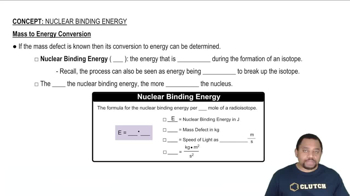
Nuclear Binding Energy

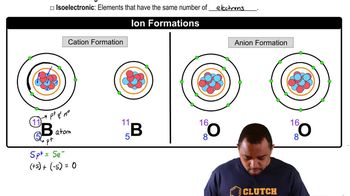
Heavy-Ion Bombardment

Heavy-ion bombardment is a technique used in nuclear physics where heavy ions, such as those from elements like calcium or curium, are accelerated and directed at target nuclei. This process can induce nuclear reactions that create new isotopes or elements not found in nature. The energy of the bombardment is significant for overcoming the repulsive forces between positively charged nuclei.
Video consigliato:

Balancing Nuclear Reactions

Balancing nuclear reactions requires ensuring that both the mass number and atomic number are conserved. This means that the total number of protons and neutrons before the reaction must equal the total after the reaction. In the given reaction, identifying the missing product involves calculating the difference in mass and atomic numbers between the reactants and products.
Video consigliato:
Percorso guidato
01:04
Balancing Basic Redox Reactions
Pratica correlata
Domanda del libro di testo

Chlorine has two stable nuclides, 35Cl and 37Cl. In contrast, 36Cl is a radioactive nuclide that decays by beta emission. (b) Based on the empirical rules about nuclear stability, explain why the nucleus of 36Cl is less stable than either 35Cl or 37Cl.

Domanda del libro di testo

In 2010, a team of scientists from Russia and the United States reported creation of the first atom of element 117, which is named tennessine, and whose symbol is Ts. The synthesis involved the collision of a target of 24997Bk with accelerated ions of an isotope which we will denote Q. The product atom, which we will call Z, immediately releases neutrons and forms 294117Ts: 24997Bk + Q → Z → 294117Ts + 3 10n (a) What are the identities of isotopes Q and Z? (c) Collision of ions of isotope Q with a target was also used to produce the first atoms of livermorium, Lv. The initial product of this collision was 296116Lv. What was the target isotope with which Q collided in this experiment?

Domanda del libro di testo

In 2010, a team of scientists from Russia and the United States reported creation of the first atom of element 117, which is named tennessine, and whose symbol is Ts. The synthesis involved the collision of a target of 24997Bk with accelerated ions of an isotope which we will denote Q. The product atom, which we will call Z, immediately releases neutrons and forms 294117Ts: 24997Bk + Q → Z → 294117Ts + 3 10n (b) Isotope Q is unusual in that it is very long-lived (its half-life is on the order of 1019 yr) in spite of having an unfavorable neutron-to-proton ratio (Figure 21.1). Can you propose a reason for its unusual stability?

404
views
Domanda del libro di testo

Chlorine has two stable nuclides, 35Cl and 37Cl. In contrast, 36Cl is a radioactive nuclide that decays by beta emission. (a) What is the product of decay of 36Cl?

464
views