Ch.21 - Nuclear Chemistry
Brown - Chemistry: The Central Science 15th Edition
Brown15th EditionChemistry: The Central ScienceISBN: 9780137542970Non è quello che usi tu?Cambia libro di testo
Capitolo 21, Problema 54

The isotope 6228Ni has the largest binding energy per nucleon of any isotope. Calculate this value from the atomic mass of nickel-62 (61.928345 amu) and compare it with the value given for iron-56 in Table 21.7.

Guida verificata passo dopo passo
1
Step 1: Understand the concept of binding energy per nucleon. Binding energy is the energy required to disassemble a nucleus into its component protons and neutrons. The binding energy per nucleon is the total binding energy divided by the number of nucleons in the nucleus.
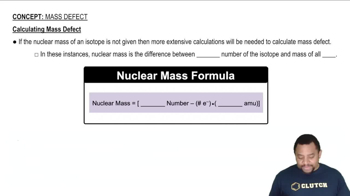
Step 2: Calculate the mass defect for nickel-62. The mass defect is the difference between the mass of the completely separated nucleons and the mass of the nucleus. Use the formula: \( \Delta m = Zm_p + Nm_n - m_{\text{nucleus}} \), where \( Z \) is the number of protons, \( N \) is the number of neutrons, \( m_p \) is the mass of a proton, \( m_n \) is the mass of a neutron, and \( m_{\text{nucleus}} \) is the atomic mass of the isotope.
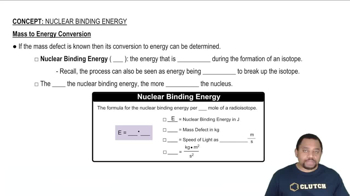
Step 3: Convert the mass defect from atomic mass units (amu) to energy using Einstein’s equation \( E = \Delta mc^2 \), where \( c \) is the speed of light. Note that 1 amu is equivalent to 931.5 MeV/c^2.
Step 4: Calculate the binding energy per nucleon by dividing the total binding energy by the number of nucleons in nickel-62. The number of nucleons is the sum of protons and neutrons, which is 62 for nickel-62.
Step 5: Compare the calculated binding energy per nucleon for nickel-62 with the value given for iron-56 in Table 21.7. This comparison will help you understand why nickel-62 has the largest binding energy per nucleon.

Concetti chiave

Ecco i concetti essenziali che devi comprendere per rispondere correttamente alla domanda.

Binding Energy

Binding energy is the energy required to disassemble a nucleus into its constituent protons and neutrons. It is a measure of the stability of a nucleus; the higher the binding energy, the more stable the nucleus. This energy can be calculated using the mass defect, which is the difference between the mass of the individual nucleons and the mass of the nucleus itself.
Video consigliato:
Percorso guidato
02:06
Nuclear Binding Energy

Mass Defect

The mass defect is the difference between the total mass of the separate nucleons and the actual mass of the nucleus. This discrepancy arises because some mass is converted into energy during the formation of the nucleus, according to Einstein's equation E=mc². The mass defect is crucial for calculating the binding energy, as it directly relates to the energy that holds the nucleus together.
Video consigliato:
Percorso guidato
00:55
Calculating Mass Defect

Atomic Mass Unit (amu)

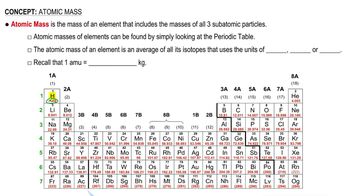
The atomic mass unit (amu) is a standard unit of mass used to express atomic and molecular weights. One amu is defined as one twelfth of the mass of a carbon-12 atom. When calculating binding energy, the atomic mass of isotopes, expressed in amu, is used to determine the mass defect and subsequently the binding energy per nucleon, allowing for comparisons between different isotopes.
Video consigliato: