
Ch.22 - Chemistry of the Nonmetals
Brown - Chemistry: The Central Science 15th Edition
Brown15th EditionChemistry: The Central ScienceISBN: 9780137542970Non è quello che usi tu?Cambia libro di testo
Capitolo 22, Problema 39

Complete the exercises below. Predict whether each of the following oxides is acidic, basic, amphoteric, or neutral: a. NO₂, b. CO₂, c. Al₂O₃, d. CaO.

Guida verificata passo dopo passo
1
Step 1: Understand the nature of oxides. Oxides can be classified as acidic, basic, amphoteric, or neutral based on their chemical behavior with water and acids/bases.
Step 2: Analyze the oxide NO₂. Nitrogen is a non-metal, and non-metal oxides typically form acidic oxides. Consider how NO₂ reacts with water to form an acid.
Step 3: Analyze the oxide CO₂. Carbon is a non-metal, and CO₂ is known to react with water to form carbonic acid, indicating it is an acidic oxide.
Step 4: Analyze the oxide Al₂O₃. Aluminum is a metal, but Al₂O₃ is known to react with both acids and bases, which is characteristic of amphoteric oxides.
Step 5: Analyze the oxide CaO. Calcium is a metal, and metal oxides typically form basic oxides. Consider how CaO reacts with water to form a base.

Concetti chiave

Ecco i concetti essenziali che devi comprendere per rispondere correttamente alla domanda.

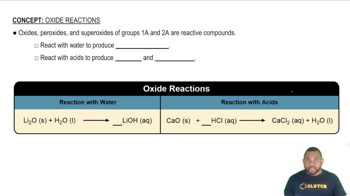
Acidic and Basic Oxides

Oxides can be classified based on their behavior in reactions with acids and bases. Acidic oxides, such as CO₂, react with bases to form salts and water, while basic oxides, like CaO, react with acids to produce salts and water. This classification is essential for predicting the nature of the oxides in the given question.
Video consigliato:
Percorso guidato
00:58
Oxide Reactions

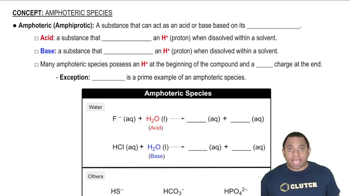
Amphoteric Oxides

Amphoteric oxides can react with both acids and bases, exhibiting dual behavior. An example is Al₂O₃, which can react with hydrochloric acid to form aluminum chloride and with sodium hydroxide to form sodium aluminate. Understanding this property is crucial for determining the classification of certain oxides.
Video consigliato:
Percorso guidato
03:03
Amphoteric Species

Neutral Oxides

Neutral oxides do not exhibit acidic or basic properties and do not react with either acids or bases. Examples include gases like NO, which do not form salts with acids or bases. Recognizing neutral oxides helps in accurately predicting the behavior of the oxides listed in the question.
Video consigliato:
Percorso guidato
00:58
Oxide Reactions