Ch.22 - Chemistry of the Nonmetals

Brown15th EditionChemistry: The Central ScienceISBN: 9780137542970
Non è quello che usi tu?Cambia libro di testoScegli un libro di testo diverso
TOC.tableOfContents
- Ch.1 - Introduction: Matter, Energy, and Measurement146
- Ch.2 - Atoms, Molecules, and Ions200
- Ch.3 - Chemical Reactions and Reaction Stoichiometry176
- Ch.4 - Reactions in Aqueous Solution155
- Ch.5 - Thermochemistry126
- Ch.6 - Electronic Structure of Atoms131
- Ch.7 - Periodic Properties of the Elements126
- Ch.8 - Basic Concepts of Chemical Bonding123
- Ch.9 - Molecular Geometry and Bonding Theories143
- Ch.10 - Gases147
- Ch.11 - Liquids and Intermolecular Forces91
- Ch.12 - Solids and Modern Materials122
- Ch.13 - Properties of Solutions126
- Ch.14 - Chemical Kinetics174
- Ch.15 - Chemical Equilibrium101
- Ch.16 - Acid-Base Equilibria139
- Ch.17 - Additional Aspects of Aqueous Equilibria146
- Ch.18 - Chemistry of the Environment72
- Ch.19 - Chemical Thermodynamics129
- Ch.20 - Electrochemistry142
- Ch.21 - Nuclear Chemistry101
- Ch.22 - Chemistry of the Nonmetals68
- Ch.23 - Transition Metals and Coordination Chemistry66
- Ch.24 - The Chemistry of Life: Organic and Biological Chemistry10
Brown15th EditionChemistry: The Central ScienceISBN: 9780137542970Non è quello che usi tu?Cambia libro di testo

Capitolo 22, Problema 72
Complete the exercises below. Select the member of group 4A that best fits each description: a. forms chains to the greatest extent, b. forms the most basic oxide, c. is a metalloid that can form an oxide.
 Guida verificata passo dopo passo
1
Step 1: Identify the elements in group 4A of the periodic table. These elements are carbon (C), silicon (Si), germanium (Ge), tin (Sn), and lead (Pb).
Step 2: For part (a), consider which element forms chains to the greatest extent. Carbon is known for its ability to form long chains and complex structures due to its tetravalency and ability to form stable covalent bonds with itself.
Step 3: For part (b), determine which element forms the most basic oxide. Basic oxides are typically formed by metals. In group 4A, tin (Sn) and lead (Pb) are metals, and their oxides tend to be more basic compared to the oxides of nonmetals or metalloids.
Step 4: For part (c), identify the metalloid in group 4A that can form an oxide. Silicon (Si) and germanium (Ge) are metalloids in this group. Both can form oxides, but silicon is more commonly known for forming silicon dioxide (SiO₂).
Step 5: Review the properties of each element in group 4A to ensure the correct selection for each description, considering their chemical behavior and common compounds they form.
Concetti chiave
Ecco i concetti essenziali che devi comprendere per rispondere correttamente alla domanda.
Group 4A Elements
Group 4A of the periodic table includes carbon (C), silicon (Si), germanium (Ge), tin (Sn), and lead (Pb). These elements exhibit a range of properties, from nonmetals to metals, and are known for their ability to form covalent bonds. Understanding their bonding characteristics is essential for predicting their behavior in various chemical reactions.
Video consigliato:
Percorso guidato
 00:50
00:50
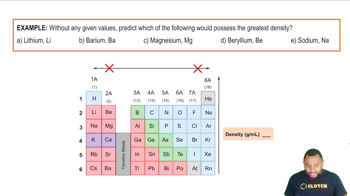
Main Group Elements: Density Example
Oxide Formation
Oxides are compounds formed when elements react with oxygen. The nature of the oxide (acidic, basic, or amphoteric) depends on the element's position in the periodic table. For example, nonmetals typically form acidic oxides, while metals form basic oxides. Recognizing the type of oxide formed by each Group 4A element is crucial for answering the question.
Video consigliato:
Percorso guidato
 02:34
02:34Enthalpy of Formation
Metalloids
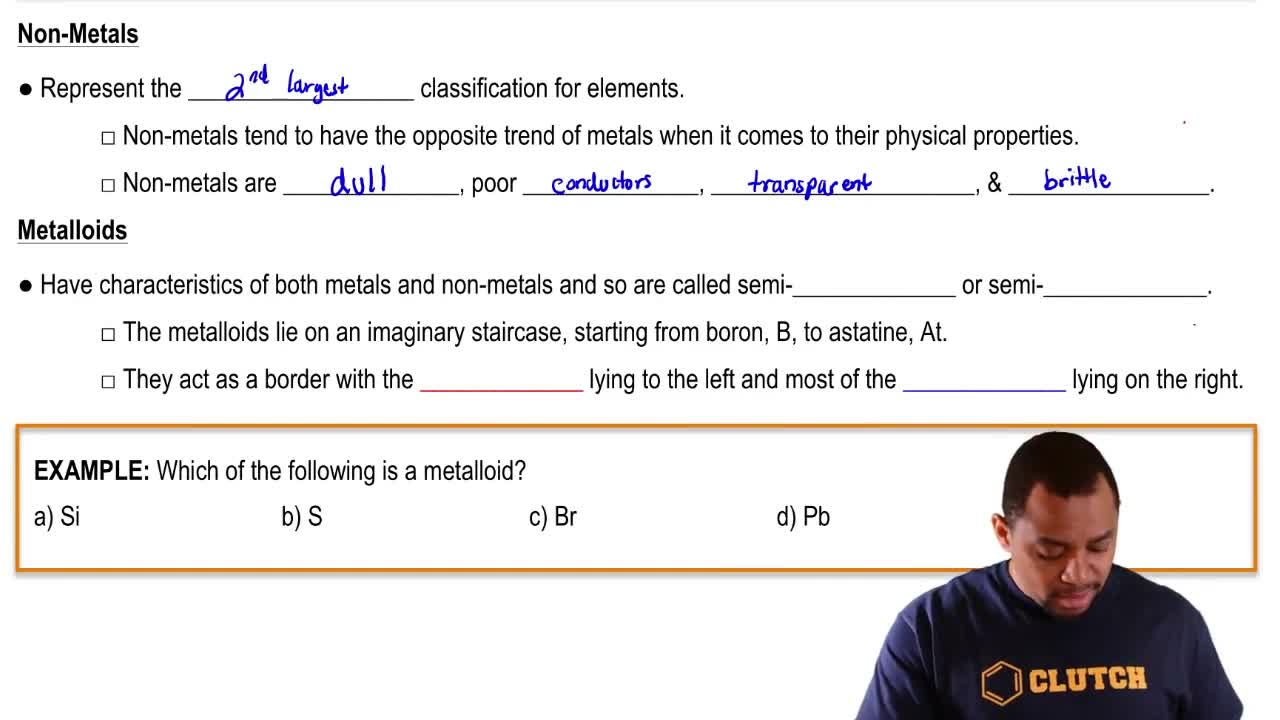
Metalloids are elements that exhibit properties of both metals and nonmetals. In Group 4A, silicon and germanium are classified as metalloids. They can form covalent bonds and oxides, which can display amphoteric behavior, meaning they can react with both acids and bases. Identifying metalloids is important for understanding their unique chemical properties.
Video consigliato:
Percorso guidato
 03:37
03:37Metalloid Properties
Pratica correlata