
Ch.23 - Transition Metals and Coordination Chemistry
Brown - Chemistry: The Central Science 15th Edition
Brown15th EditionChemistry: The Central ScienceISBN: 9780137542970Non è quello che usi tu?Cambia libro di testo
Capitolo 23, Problema 77

Carbon monoxide, CO, is an important ligand in coordination chemistry. When CO is reacted with nickel metal, the product is [Ni(CO)4] which is a toxic, pale yellow liquid.
a. What is the oxidation number for nickel in this compound?
b. Given that [Ni(CO)4] is a diamagnetic molecule with a tetrahedral geometry, what is the electron configuration of nickel in this compound?
c. Write the name for [Ni(CO)4] using the nomenclature rules for coordination compounds.

Guida verificata passo dopo passo
1
1. To find the oxidation number of nickel in [Ni(CO)4], remember that the oxidation number of a molecule is the charge it would have if all bonds were ionic. Carbon monoxide (CO) is a neutral ligand, meaning it does not contribute to the overall charge of the complex. Therefore, the oxidation number of nickel in this compound is 0.
2. To determine the electron configuration of nickel in [Ni(CO)4], we need to know the atomic number of nickel, which is 28. This means it has 28 electrons in its neutral state. Since the oxidation state of nickel in this compound is 0, it means that nickel has not lost or gained any electrons, so it still has 28 electrons. The electron configuration of a neutral nickel atom is [Ar] 3d8 4s2. However, in coordination compounds, the 4s electrons are often moved to the 3d orbitals. Therefore, the electron configuration of nickel in this compound is [Ar] 3d10.
3. To name [Ni(CO)4] using the nomenclature rules for coordination compounds, first name the ligands in alphabetical order, then the metal. The prefix 'tetra-' is used to indicate that there are four CO ligands. Since the oxidation state of nickel is 0, no Roman numeral is needed in the name. Therefore, the name of this compound is tetracarbonylnickel.

Risposta video verificata per un problema simile:

Questa soluzione video è stata consigliata dai nostri tutor come utile per risolvere questo problema.
Durata del video:
3m

Concetti chiave

Ecco i concetti essenziali che devi comprendere per rispondere correttamente alla domanda.

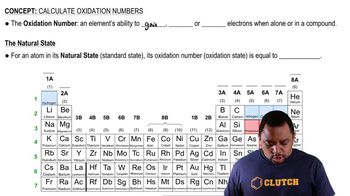
Oxidation Number

The oxidation number is a theoretical charge assigned to an atom in a compound, reflecting its degree of oxidation or reduction. In coordination compounds, the oxidation state of the central metal ion can be determined by considering the charges of the ligands attached to it. For example, in [Ni(CO)4], carbon monoxide (CO) is a neutral ligand, which helps in calculating the oxidation state of nickel.
Video consigliato:
Percorso guidato
02:42
Oxidation Numbers

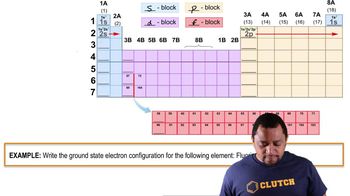
Electron Configuration

Electron configuration describes the distribution of electrons in an atom's orbitals. For transition metals like nickel, the electron configuration is crucial for understanding their chemical behavior and bonding. In the case of [Ni(CO)4], the electron configuration of nickel must be adjusted to account for the coordination with CO ligands, which can influence the metal's d-orbital occupancy and overall geometry.
Video consigliato:
Percorso guidato
01:33
Electron Configuration Example

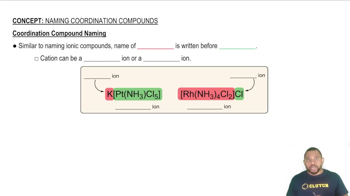
Coordination Compound Nomenclature

Coordination compound nomenclature involves specific rules for naming complexes that include a central metal atom and surrounding ligands. The name typically starts with the ligands listed in alphabetical order, followed by the metal's name, which may include its oxidation state in Roman numerals. For [Ni(CO)4], the name would reflect the neutral CO ligands and the nickel center, adhering to these nomenclature conventions.
Video consigliato:
Percorso guidato
01:32
Coordination Compound Naming