Ch.23 - Transition Metals and Coordination Chemistry

Brown15th EditionChemistry: The Central ScienceISBN: 9780137542970
Non è quello che usi tu?Cambia libro di testoScegli un libro di testo diverso
TOC.tableOfContents
- Ch.1 - Introduction: Matter, Energy, and Measurement146
- Ch.2 - Atoms, Molecules, and Ions200
- Ch.3 - Chemical Reactions and Reaction Stoichiometry176
- Ch.4 - Reactions in Aqueous Solution155
- Ch.5 - Thermochemistry126
- Ch.6 - Electronic Structure of Atoms131
- Ch.7 - Periodic Properties of the Elements126
- Ch.8 - Basic Concepts of Chemical Bonding123
- Ch.9 - Molecular Geometry and Bonding Theories143
- Ch.10 - Gases147
- Ch.11 - Liquids and Intermolecular Forces91
- Ch.12 - Solids and Modern Materials122
- Ch.13 - Properties of Solutions126
- Ch.14 - Chemical Kinetics174
- Ch.15 - Chemical Equilibrium101
- Ch.16 - Acid-Base Equilibria139
- Ch.17 - Additional Aspects of Aqueous Equilibria146
- Ch.18 - Chemistry of the Environment72
- Ch.19 - Chemical Thermodynamics129
- Ch.20 - Electrochemistry142
- Ch.21 - Nuclear Chemistry101
- Ch.22 - Chemistry of the Nonmetals68
- Ch.23 - Transition Metals and Coordination Chemistry66
- Ch.24 - The Chemistry of Life: Organic and Biological Chemistry10
Brown15th EditionChemistry: The Central ScienceISBN: 9780137542970Non è quello che usi tu?Cambia libro di testo
Tutti i libri di testo Brown 15th EditionCh.23 - Transition Metals and Coordination ChemistryProblema 29
Brown 15th EditionCh.23 - Transition Metals and Coordination ChemistryProblema 29Capitolo 23, Problema 29
Complete the exercises below. Polydentate ligands can vary in the number of coordination positions they occupy. In each of the following, identify the polydentate ligand present and indicate the probable number of coordination positions it occupies: a. [Co(NH₃)₄ (o-phen)] Cl₃.
 Guida verificata passo dopo passo
1
Identify the ligands present in the complex. In [Co(NH₃)_4(o-phen)]Cl₃, the ligands are NH₃ (ammonia) and o-phen (ortho-phenanthroline).
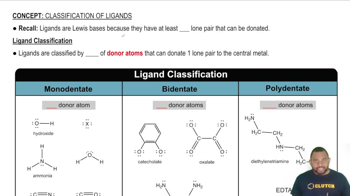
Determine which ligand is polydentate. NH₃ is a monodentate ligand, meaning it can only occupy one coordination position. o-phen, however, is a polydentate ligand.
Understand the structure of o-phen (ortho-phenanthroline). It is a bidentate ligand, meaning it can form two bonds with the central metal ion, Co in this case.
Count the coordination positions occupied by o-phen. Since o-phen is bidentate, it occupies two coordination positions.
Summarize the findings: In the complex [Co(NH₃)_4(o-phen)]Cl₃, the polydentate ligand is o-phen, and it occupies two coordination positions.
Concetti chiave
Ecco i concetti essenziali che devi comprendere per rispondere correttamente alla domanda.
Polydentate Ligands
Polydentate ligands are molecules that can attach to a central metal atom at multiple coordination sites. This ability allows them to form stable complexes with metal ions, as they create multiple bonds, enhancing the overall stability of the complex. Common examples include ethylenediamine and oxalate, which can bind through two or more donor atoms.
Video consigliato:
Percorso guidato
 04:22
04:22
Ligand Classification
Coordination Number
The coordination number refers to the total number of ligand donor atoms that are bonded to a central metal ion in a coordination complex. It is determined by the number of bonds formed between the ligands and the metal. For polydentate ligands, the coordination number can be higher than for monodentate ligands, as they can occupy multiple positions simultaneously.
Video consigliato:
Percorso guidato
 00:27
00:27Coordination Numbers
Chelation
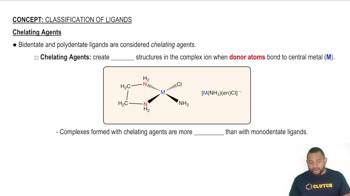
Chelation is the process by which a polydentate ligand forms a complex with a metal ion, effectively 'grabbing' the metal through multiple coordination sites. This interaction often results in more stable complexes compared to those formed with monodentate ligands. Chelating agents are widely used in various applications, including medicine and environmental science, to sequester metal ions.
Video consigliato:
Percorso guidato
 01:21
01:21Chelating Agents
Pratica correlata