Balance the following equations and indicate whether they are combination, decomposition, or combustion reactions: (b) NH4NO3(s) → N2O(g) + H2O(g) (c) Zn(OH)2(s) → ZnO(s) + H2O(l) (d) Ag2O(s) → Ag(s) + O2(g)
Ch.3 - Chemical Reactions and Reaction Stoichiometry

Brown15th EditionChemistry: The Central ScienceISBN: 9780137542970Non è quello che usi tu?Cambia libro di testo
Tutti i libri di testo
Brown 15th Edition
Ch.3 - Chemical Reactions and Reaction Stoichiometry
Problema 23
Brown 15th Edition
Ch.3 - Chemical Reactions and Reaction Stoichiometry
Problema 23Capitolo 3, Problema 23
Determine the formula weights of each of the following compounds: (a) lead(IV) chloride (b) copper(II) oxide (c) iodic acid, HIO3 (d) sodium perchlorate, NaClO4
Guida verificata passo dopo passo1
Step 1: Identify the chemical formula for each compound. For lead(IV) chloride, the formula is PbCl4. For copper(II) oxide, the formula is CuO. For iodic acid, the formula is HIO3. For sodium perchlorate, the formula is NaClO4.
Step 2: Determine the atomic weights of each element involved in the compounds using the periodic table. For example, lead (Pb) has an atomic weight of approximately 207.2 amu, chlorine (Cl) is about 35.45 amu, copper (Cu) is about 63.55 amu, oxygen (O) is about 16.00 amu, iodine (I) is about 126.90 amu, sodium (Na) is about 22.99 amu.
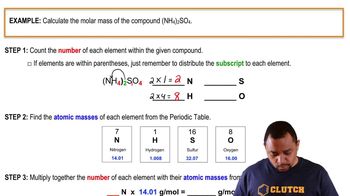
Step 3: Calculate the formula weight for each compound by multiplying the atomic weight of each element by the number of atoms of that element in the formula, and then summing these values. For PbCl4, calculate (1 x 207.2) + (4 x 35.45). For CuO, calculate (1 x 63.55) + (1 x 16.00). For HIO3, calculate (1 x 126.90) + (3 x 16.00). For NaClO4, calculate (1 x 22.99) + (1 x 35.45) + (4 x 16.00).
Step 4: Add the calculated values for each element in the compound to find the total formula weight. This involves summing the products from the previous step for each compound.
Step 5: Review the calculations to ensure accuracy and consistency with the atomic weights and the chemical formulas provided. This step ensures that the formula weights are correctly determined for each compound.
Concetti chiave
Ecco i concetti essenziali che devi comprendere per rispondere correttamente alla domanda.
Molar Mass Calculation
Molar mass is the mass of one mole of a substance, typically expressed in grams per mole (g/mol). It is calculated by summing the atomic masses of all atoms in a chemical formula, taking into account the number of each type of atom present. For example, in lead(IV) chloride (PbCl4), the molar mass is calculated by adding the atomic mass of lead (207.2 g/mol) to four times the atomic mass of chlorine (35.5 g/mol).
Video consigliato:
Percorso guidato
Molar Mass Calculation Example
Chemical Nomenclature
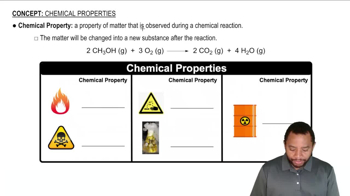
Chemical nomenclature is the system of naming chemical compounds based on their composition and structure. It follows specific rules set by organizations like IUPAC. For instance, lead(IV) chloride indicates that lead has a +4 oxidation state, while copper(II) oxide indicates copper has a +2 oxidation state. Understanding these names helps in identifying the correct formulas and their corresponding weights.
Video consigliato:
Percorso guidato
Chemical Properties
Polyatomic Ions
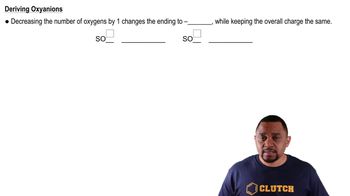
Polyatomic ions are charged entities composed of two or more atoms covalently bonded, which function as a single ion. Examples include the perchlorate ion (ClO4-) in sodium perchlorate (NaClO4) and the iodate ion (IO3-) in iodic acid (HIO3). Recognizing these ions is crucial for correctly writing formulas and calculating their weights, as they often dictate the overall charge and composition of the compound.
Video consigliato:
Percorso guidato
Polyatomic Ion Variations
Pratica correlata
Domanda del libro di testo
337
views
Domanda del libro di testo
Determine the formula weights of each of the following compounds: e. benzaldehyde, C6H5CHO, the molecule largely responsible for the odor of almond extract.
2
views
Domanda del libro di testo
Balance the following equations and indicate whether they are combination, decomposition, or combustion reactions: (a) C3H6(s) + O2(g) → CO2(g) + H2O(l)
415
views
Domanda del libro di testo
Calculate the percentage by mass of oxygen in the following compounds: b. codeine, C18H21NO3
2
views
Domanda del libro di testo
Balance the following equations and indicate whether they are combination, decomposition, or combustion reactions: a. PbCO3(s) → PbO(s) + CO2(g)
2
views
Domanda del libro di testo
Calculate the percentage by mass of oxygen in the following compounds: a. morphine, C17H19NO3
2
views