Ch.3 - Chemical Reactions and Reaction Stoichiometry
Brown - Chemistry: The Central Science 15th Edition
Brown15th EditionChemistry: The Central ScienceISBN: 9780137542970Non è quello che usi tu?Cambia libro di testo
Capitolo 3, Problema 46a

Determine the empirical formula of each of the following compounds if a sample contains a. 0.104 mol K, 0.052 mol C, and 0.156 mol O;

Guida verificata passo dopo passo
1
Determine the simplest whole number ratio of moles of each element in the compound.
Identify the moles of each element: K = 0.104 mol, C = 0.052 mol, O = 0.156 mol.
Divide the moles of each element by the smallest number of moles present in the sample, which is 0.052 mol in this case.
Calculate the ratios: \( \frac{0.104}{0.052} \) for K, \( \frac{0.052}{0.052} \) for C, and \( \frac{0.156}{0.052} \) for O.
Use the resulting ratios to write the empirical formula, ensuring all are whole numbers.

Risposta video verificata per un problema simile:

Questa soluzione video è stata consigliata dai nostri tutor come utile per risolvere questo problema.
Durata del video:
51s

Concetti chiave

Ecco i concetti essenziali che devi comprendere per rispondere correttamente alla domanda.

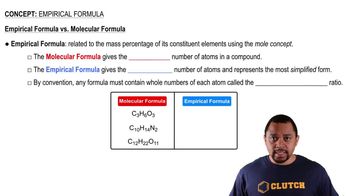
Empirical Formula

The empirical formula of a compound represents the simplest whole-number ratio of the elements present in that compound. It is derived from the number of moles of each element in a sample, providing a basic understanding of the composition without indicating the actual number of atoms in a molecule.
Video consigliato:
Percorso guidato
02:26
Empirical vs Molecular Formula

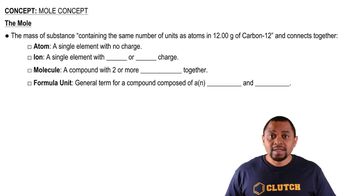
Mole Concept

The mole is a fundamental unit in chemistry that quantifies the amount of substance. One mole corresponds to approximately 6.022 x 10^23 entities (atoms, molecules, etc.). Understanding the mole concept is essential for converting between mass, number of particles, and volume in chemical calculations.
Video consigliato:

Mole Ratio

Mole ratio is the ratio of the amounts in moles of any two compounds involved in a chemical reaction. In determining the empirical formula, the mole ratio of the elements is calculated by dividing the number of moles of each element by the smallest number of moles present, simplifying the ratio to its lowest terms.
Video consigliato:
Percorso guidato
02:14
Neutron-Proton Ratio