

Ch.3 - Chemical Reactions and Reaction Stoichiometry
Brown - Chemistry: The Central Science 15th Edition
Brown15th EditionChemistry: The Central ScienceISBN: 9780137542970Non è quello che usi tu?Cambia libro di testo
Capitolo 3, Problema 6b

The following diagram represents a high-temperature reaction between CH4 and H2O. Based on this reaction, find how many moles of each product can be obtained starting with 4.0 mol CH4. Based on this reaction, how many moles of H2 can be obtained starting with 4.0 mol CH4?

Guida verificata passo dopo passo
1
Step 1: Write down the balanced chemical equation for the reaction. The reaction between CH4 and H2O at high temperature is CH4 + H2O -> CO + 3H2. This equation tells us that one mole of CH4 reacts with one mole of H2O to produce one mole of CO and three moles of H2.
Step 2: Identify the given and what needs to be found. In this case, we are given that we have 4.0 mol of CH4 and we need to find out how many moles of each product can be obtained.
Step 3: Use the stoichiometry of the reaction to calculate the moles of the products. According to the balanced chemical equation, one mole of CH4 produces one mole of CO and three moles of H2. Therefore, 4.0 mol of CH4 will produce 4.0 mol of CO and 4.0*3 = 12.0 mol of H2.
Step 4: Therefore, starting with 4.0 mol CH4, we can obtain 4.0 mol CO and 12.0 mol H2.
Step 5: To answer the second part of the question, how many moles of H2 can be obtained starting with 4.0 mol CH4, we already calculated that in step 3. So, starting with 4.0 mol CH4, we can obtain 12.0 mol H2.

Risposta video verificata per un problema simile:

Questa soluzione video è stata consigliata dai nostri tutor come utile per risolvere questo problema.
Durata del video:
2m

Concetti chiave

Ecco i concetti essenziali che devi comprendere per rispondere correttamente alla domanda.

Stoichiometry

Stoichiometry is the branch of chemistry that deals with the quantitative relationships between the reactants and products in a chemical reaction. It allows us to calculate the amount of products formed or reactants consumed based on balanced chemical equations. Understanding stoichiometry is essential for determining how many moles of products can be produced from a given amount of reactants.
Video consigliato:
Percorso guidato
01:16
Stoichiometry Concept

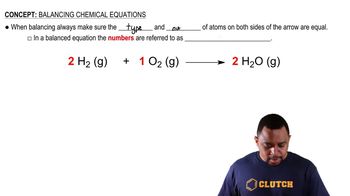
Balanced Chemical Equation

A balanced chemical equation represents a chemical reaction with equal numbers of each type of atom on both sides of the equation. It provides the mole ratios of reactants and products, which are crucial for stoichiometric calculations. For the reaction between CH4 and H2O, knowing the balanced equation helps in determining the moles of H2 produced from a specific amount of CH4.
Video consigliato:
Percorso guidato
01:32
Balancing Chemical Equations

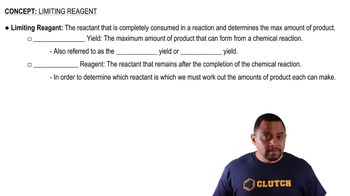
Limiting Reactant

The limiting reactant is the substance that is completely consumed first in a chemical reaction, thus determining the maximum amount of product that can be formed. Identifying the limiting reactant is vital for accurate stoichiometric calculations, as it dictates how much of the other reactants will remain unreacted. In this case, understanding which reactant limits the production of H2 from CH4 is key to solving the problem.
Video consigliato:
Percorso guidato
01:30
Limiting Reagent Concept
Pratica correlata
Domanda del libro di testo

The following diagram represents a high-temperature reaction between CH4 and H2O. Based on this reaction, find how many moles of each product can be obtained starting with 4.0 mol CH4.

Based on this reaction, find how many moles of CO can be obtained starting with 4.0 mol CH4?

904
views
1
rank
Domanda del libro di testo

Nitrogen 1N22 and hydrogen 1H22 react to form ammonia 1NH32. Consider the mixture of N2 and H2 shown in the accompanying diagram. The blue spheres represent N, and the white ones represent H. (d) Are any reactant molecules left over, based on the diagram?

440
views
Domanda del libro di testo

Glycine, an amino acid used by organisms to make proteins, is represented by the following molecular model. (c) Calculate how many moles of glycine are in a 100.0-g sample of glycine.

580
views
Domanda del libro di testo

Glycine, an amino acid used by organisms to make proteins, is represented by the following molecular model. (d) Calculate the percent nitrogen by mass in glycine.

832
views
Domanda del libro di testo

Nitrogen 1N22 and hydrogen 1H22 react to form ammonia 1NH32. Consider the mixture of N2 and H2 shown in the accompanying diagram. The blue spheres represent N, and the white ones represent H. (a) Write the balanced chemical equation for the reaction.

525
views
1
rank
Domanda del libro di testo

Nitrogen 1N22 and hydrogen 1H22 react to form ammonia 1NH32. Consider the mixture of N2 and H2 shown in the accompanying diagram. The blue spheres represent N, and the white ones represent H. (d) If so, how many of which type are left over?

How many N2 molecules are left over?

461
views