

The following diagram shows the combination reaction between hydrogen, H2, and carbon monoxide, CO, to produce methanol, CH3OH (white spheres are H, black spheres are C, red spheres are O). The correct number of CO molecules involved in this reaction is not shown. (b) Write a balanced chemical equation for the reaction.
Ch.3 - Chemical Reactions and Reaction Stoichiometry

Brown15th EditionChemistry: The Central ScienceISBN: 9780137542970Non è quello che usi tu?Cambia libro di testo
Tutti i libri di testo
Brown 15th Edition
Ch.3 - Chemical Reactions and Reaction Stoichiometry
Problema 1
Brown 15th Edition
Ch.3 - Chemical Reactions and Reaction Stoichiometry
Problema 1Capitolo 3, Problema 1
The reaction between reactant A (blue spheres) and reactant B (red spheres) is shown in the following diagram:
Based on this diagram, which equation best describes the reaction? (a) A2 + B¡A2B (b) A2 + 4 B¡2 AB2 (c) 2 A + B4¡2 AB2 (d) A + B2¡AB2
Guida verificata passo dopo passo1
Identify the reactants and products in the diagram. Count the number of blue spheres (representing A) and red spheres (representing B) in the reactants and products.
Write down the initial and final counts of each type of sphere. This will help you determine the stoichiometry of the reaction.
Compare the stoichiometry you derived from the diagram with the stoichiometry given in each reaction option. Match the number of A and B atoms on both sides of the equation.
Check for conservation of mass in each reaction option to ensure that the number of each type of atom is the same on both sides of the equation.
Select the equation where the stoichiometry matches the diagram and the law of conservation of mass is obeyed.

Risposta video verificata per un problema simile:
Questa soluzione video è stata consigliata dai nostri tutor come utile per risolvere questo problema.
Durata del video:
1mConcetti chiave
Ecco i concetti essenziali che devi comprendere per rispondere correttamente alla domanda.
Stoichiometry
Stoichiometry is the branch of chemistry that deals with the quantitative relationships between the reactants and products in a chemical reaction. It involves using balanced chemical equations to determine the proportions of substances involved, allowing chemists to predict how much of each reactant is needed and how much product will be formed.
Video consigliato:
Percorso guidato
Stoichiometry Concept
Chemical Equations
A chemical equation is a symbolic representation of a chemical reaction, showing the reactants on the left and the products on the right. It must be balanced to comply with the law of conservation of mass, meaning the number of atoms for each element must be the same on both sides of the equation. Understanding how to interpret and balance these equations is crucial for analyzing reactions.
Video consigliato:
Percorso guidato
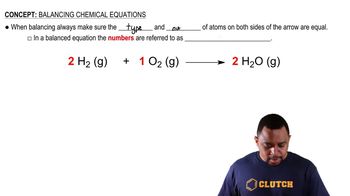
Balancing Chemical Equations
Molecular Representation
Molecular representation involves visualizing molecules using symbols or diagrams, such as spheres representing atoms. In the context of the question, blue and red spheres represent different reactants, which helps in understanding how they interact and combine during a reaction. This visualization aids in formulating the correct chemical equation based on the observed interactions.
Video consigliato:
Percorso guidato
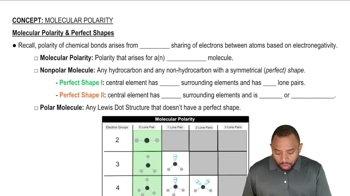
Molecular Polarity
Pratica correlata
Domanda del libro di testo
457
views
Domanda del libro di testo
The following diagram represents the collection of elements formed by a decomposition reaction. (a) If the blue spheres represent N atoms and the red ones represent O atoms, what was the empirical formula of the original compound?
741
views
1
rank
Domanda del libro di testo
The following diagram shows the combination reaction between hydrogen, H2, and carbon monoxide, CO, to produce methanol, CH3OH (white spheres are H, black spheres are C, red spheres are O). The correct number of CO molecules involved in this reaction is not shown. (a) Determine the number of CO molecules that should be shown in the left (reactants) box.
609
views
1
rank