Ch.4 - Reactions in Aqueous Solution
Brown - Chemistry: The Central Science 15th Edition
Brown15th EditionChemistry: The Central ScienceISBN: 9780137542970Non è quello che usi tu?Cambia libro di testo
Capitolo 4, Problema 74b

(b) If you dilute 10.0 mL of the stock solution to a final volume of 0.250 L, what will be the concentration of the diluted solution?

Guida verificata passo dopo passo
1
Identify the initial concentration of the stock solution, denoted as C1, and the initial volume, V1, which is 10.0 mL.
Recognize that the final volume, V2, after dilution is 0.250 L (or 250 mL).
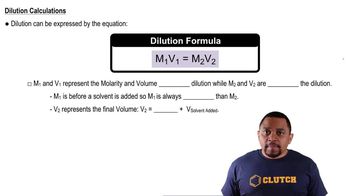
Use the dilution formula: C1 * V1 = C2 * V2, where C2 is the concentration of the diluted solution.
Rearrange the formula to solve for C2: C2 = (C1 * V1) / V2.
Substitute the known values into the equation to find the concentration of the diluted solution, C2.

Risposta video verificata per un problema simile:

Questa soluzione video è stata consigliata dai nostri tutor come utile per risolvere questo problema.
Durata del video:
1m

Concetti chiave

Ecco i concetti essenziali che devi comprendere per rispondere correttamente alla domanda.

Dilution

Dilution is the process of reducing the concentration of a solute in a solution, typically by adding more solvent. The relationship between the concentrations and volumes of the stock and diluted solutions can be described by the dilution equation, C1V1 = C2V2, where C1 and V1 are the concentration and volume of the stock solution, and C2 and V2 are the concentration and volume of the diluted solution.
Video consigliato:
Percorso guidato
00:58
Dilution Equation

Concentration

Concentration refers to the amount of solute present in a given volume of solution, often expressed in units such as molarity (moles per liter). Understanding how concentration changes during dilution is crucial for calculating the final concentration after mixing different volumes of solutions.
Video consigliato:
Percorso guidato
07:35
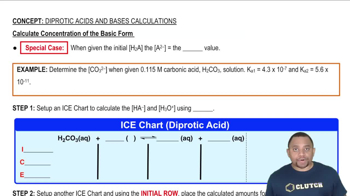
Calculate Concentration of the Basic Form

Volume

Volume is a measure of the three-dimensional space occupied by a substance, commonly measured in liters (L) or milliliters (mL). In dilution calculations, the initial and final volumes are essential for determining how the concentration of a solution changes when additional solvent is added.
Video consigliato:
Percorso guidato
02:35
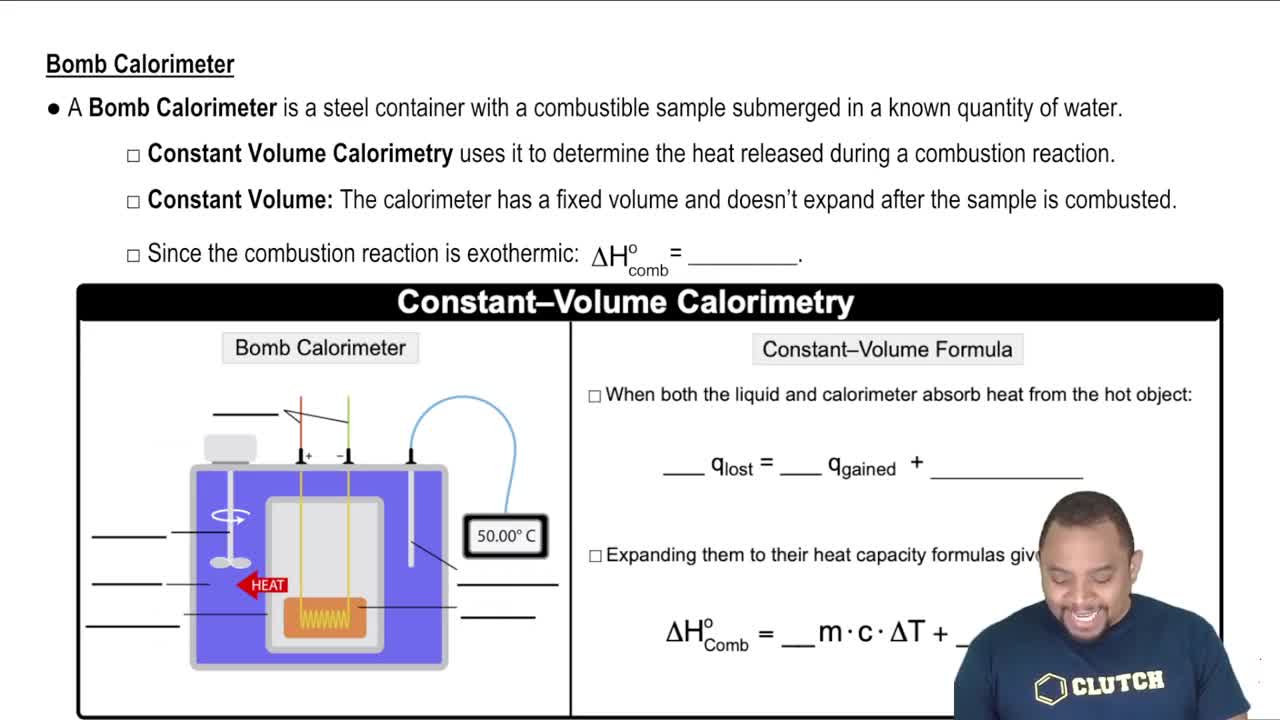
Constant-Volume Calorimetry
Pratica correlata
Domanda del libro di testo

(b) If you take a 10.0-mL portion of the stock solution and dilute it to a total volume of 0.500 L, what will be the concentration of the final solution?

1221
views

Domanda del libro di testo

Indicate the concentration of each ion present in the solution formed by mixing: (c) 3.60 g KCl in 75.0 mL of 0.250 M CaCl2 solution. Assume that the volumes are additive.

490
views
Domanda del libro di testo

Pure acetic acid, known as glacial acetic acid, is a liquid with a density of 1.049 g/mL at 25 C. Calculate the molarity of a solution of acetic acid made by dissolving 20.00 mL of glacial acetic acid at 25 C in enough water to make 250.0 mL of solution.

4577
views
2
rank
Domanda del libro di testo

(a) How many milliliters of a stock solution of 6.0 M HNO3 would you have to use to prepare 110 mL of 0.500 M HNO3?

1358
views
1
rank
Domanda del libro di testo

Calicheamicin gamma-1, C55H74IN3O21S4, is one of the most potent antibiotics known: one molecule kills one bacterial cell. Describe how you would (carefully!) prepare 25.00 mL of an aqueous calicheamicin gamma-1 solution that could kill 1.0 * 108 bacteria, starting from a 5.00 * 10-9M stock solution of the antibiotic.

841
views
Domanda del libro di testo

medical lab is testing a new anticancer drug on cancer cells. The drug stock solution concentration is 1.5 * 10-9 M, and 1.00 mL of this solution will be delivered to a dish containing 2.0 * 105 cancer cells in 5.00 mL of aqueous fluid. What is the ratio of drug molecules to the number of cancer cells in the dish?

1409
views