
The distinctive odor of vinegar is due to acetic acid, CH3COOH, which reacts with sodium hydroxide according to: CH3COOH1aq2 + NaOH1aq2¡ H2O1l2 + NaCH3COO1aq2 If 3.45 mL of vinegar needs 42.5 mL of 0.115 M NaOH to reach the equivalence point in a titration, how many grams of acetic acid are in a 1.00-qt sample of this vinegar?
Ch.4 - Reactions in Aqueous Solution

Brown15th EditionChemistry: The Central ScienceISBN: 9780137542970Non è quello che usi tu?Cambia libro di testo
Capitolo 4, Problema 82c
(c) If 55.8 mL of a BaCl2 solution is needed to precipitate all the sulfate ion in a 752-mg sample of Na2SO4, what is the molarity of the BaCl2 solution?
Guida verificata passo dopo passo1
Identify the chemical reaction: BaCl_2 + Na_2SO_4 \(\rightarrow\) BaSO_4 + 2NaCl.
Calculate the moles of Na_2SO_4 using its molar mass: \(\text{moles of Na}\)_2\(\text{SO}\)_4 = \(\frac{\text{mass of Na}\)_2\(\text{SO}\)_4}{\(\text{molar mass of Na}\)_2\(\text{SO}\)_4}.
Use the stoichiometry of the balanced equation to find the moles of BaCl_2 needed: \(\text{moles of BaCl}\)_2 = \(\text{moles of Na}\)_2\(\text{SO}\)_4.
Convert the volume of BaCl_2 solution from mL to L: \(\text{volume in L}\) = \(\frac{55.8 \text{ mL}\)}{1000}.
Calculate the molarity of the BaCl_2 solution: \(\text{Molarity}\) = \(\frac{\text{moles of BaCl}\)_2}{\(\text{volume of solution in L}\)}.

Risposta video verificata per un problema simile:
Questa soluzione video è stata consigliata dai nostri tutor come utile per risolvere questo problema.
Durata del video:
2mConcetti chiave
Ecco i concetti essenziali che devi comprendere per rispondere correttamente alla domanda.
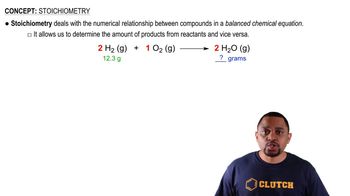
Stoichiometry
Stoichiometry is the calculation of reactants and products in chemical reactions. It involves using balanced chemical equations to determine the relationships between the amounts of substances consumed and produced. In this question, stoichiometry is essential to relate the moles of BaCl2 used to the moles of sulfate ions from Na2SO4 that are being precipitated.
Video consigliato:
Percorso guidato
Stoichiometry Concept
Molarity
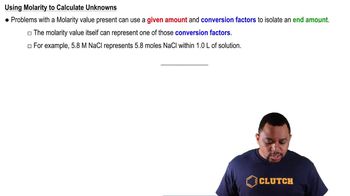
Molarity is a measure of concentration defined as the number of moles of solute per liter of solution. It is expressed in units of moles per liter (mol/L). To find the molarity of the BaCl2 solution in this problem, one must calculate the moles of BaCl2 that reacted and divide that by the volume of the solution in liters.
Video consigliato:
Percorso guidato
Molarity
Precipitation Reactions
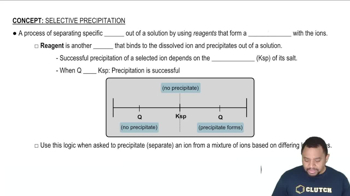
Precipitation reactions occur when two soluble salts react to form an insoluble product, known as a precipitate. In this case, BaCl2 reacts with Na2SO4 to form barium sulfate (BaSO4), which precipitates out of solution. Understanding this concept is crucial for determining how much BaCl2 is needed to completely react with the sulfate ions present in the sample.
Video consigliato:
Percorso guidato
Selective Precipitation
Pratica correlata
Domanda del libro di testo
1270
views
Domanda del libro di testo
(a) How many milliliters of 0.120 M HCl are needed to completely neutralize 50.0 mL of 0.101 M Ba(OH)2 solution?
981
views
Domanda del libro di testo
(b) How many milliliters of 0.125 M H2SO4 are needed to neutralize 0.200 g of NaOH?
805
views
Domanda del libro di testo
(d) If 45.3 mL of a 0.108 M HCl solution is needed to neutralize a solution of KOH, how many grams of KOH must be present in the solution?
628
views
Domanda del libro di testo
A 4.36-g sample of an unknown alkali metal hydroxide is dissolved in 100.0 mL of water. An acid–base indicator is added, and the resulting solution is titrated with 2.50 M HCl(aq) solution. The indicator changes color, signaling that the equivalence point has been reached, after 17.0 mL of the hydrochloric acid solution has been added. (a) What is the molar mass of the metal hydroxide?
1602
views
