
Domanda del libro di testo
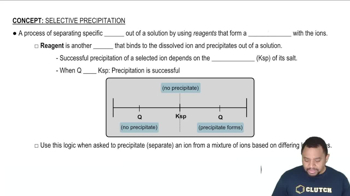
Write balanced net ionic equations for the reactions that occur in each of the following cases. Identify the spectator ion or ions in each reaction. a. Cr2(SO4)3(𝑎𝑞)+(NH4)2CO3(𝑎𝑞)⟶
6
views

 Guida verificata passo dopo passo
 01:53
01:53
 00:28
00:28 02:11
02:11Write balanced net ionic equations for the reactions that occur in each of the following cases. Identify the spectator ion or ions in each reaction. a. Cr2(SO4)3(𝑎𝑞)+(NH4)2CO3(𝑎𝑞)⟶
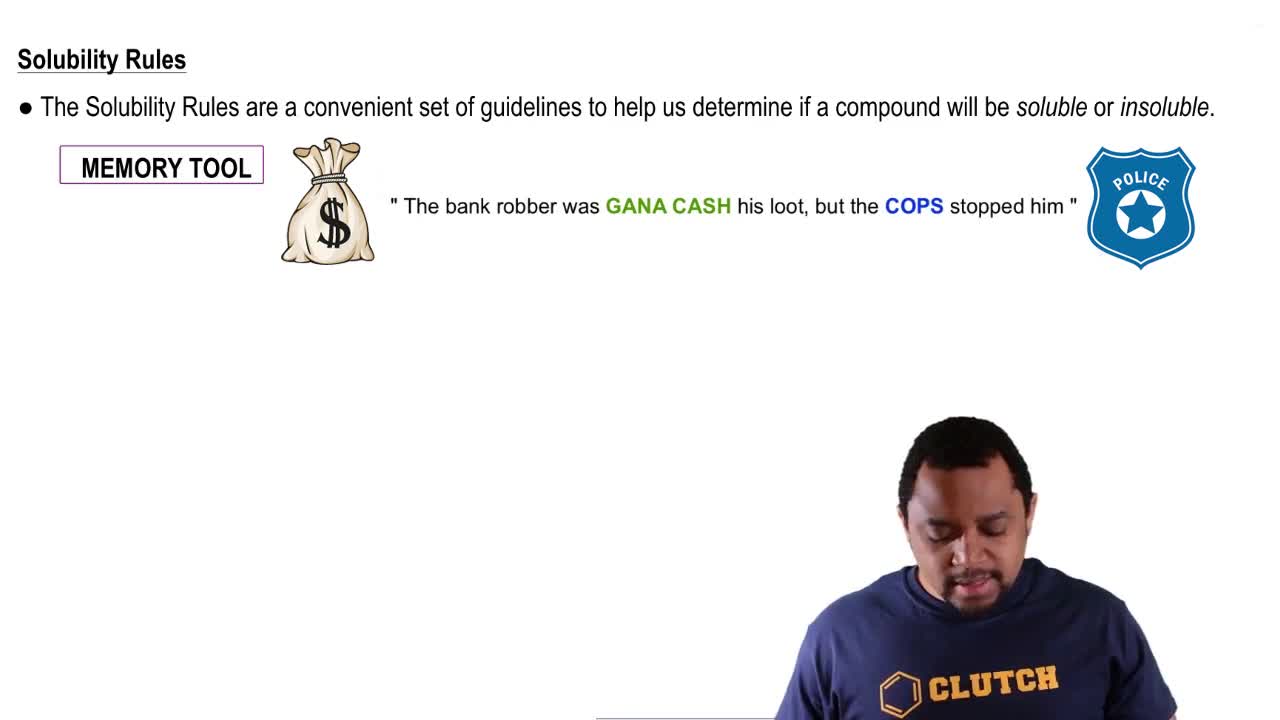
Write balanced net ionic equations for the reactions that occur in each of the following cases. Identify the spectator ion or ions in each reaction. c. Fe(NO3)2(𝑎𝑞)+KOH(𝑎𝑞)⟶
You know that an unlabeled bottle contains an aqueous solution of one of the following: AgNO3,CaCl2, or Al2(SO4)3. You take a portion of the solution and add an aqueous solution of Ba(NO3)2 to it, and observe that a white solid precipitates Then you take another portion of the unlabeled solution and add an aqueous solution of NaCl to it; nothing appears to happen. What is the most likely identity of the solution in the unlabeled bottle: silver nitrate, calcium chloride, aluminum sulfate?
Three solutions are mixed together to form a single solution; in the final solution, there are 0.2 mol Pb1CH3COO)2, 0.1 mol Na2S, and 0.1 mol CaCl2 present. What solid(s) will precipitate?
Which of the following solutions is the most acidic? a. 0.2 M LiOH b. 0.2 M HI c. 1.0 M methanol (CH3OH)