
A 0.5895-g sample of impure magnesium hydroxide is dissolved in 100.0 mL of 0.2050 M HCl solution. The excess acid then needs 19.85 mL of 0.1020 M NaOH for neutralization. Calculate the percentage by mass of magnesium hydroxide in the sample, assuming that it is the only substance reacting with the HCl solution.
Ch.4 - Reactions in Aqueous Solution

Brown15th EditionChemistry: The Central ScienceISBN: 9780137542970Non è quello che usi tu?Cambia libro di testo
Capitolo 4, Problema 92b
The accompanying photo shows the reaction between a solution of Cd(NO3)2 and one of Na2S. (b) What ions remain in solution?
Guida verificata passo dopo passo1
Identify the ions present in the reactants: Cd(NO3)2 dissociates into Cd^2+ and NO3^- ions, while Na2S dissociates into Na+ and S^2- ions.
Write the possible products of the reaction by considering the exchange of ions. The potential products are CdS and NaNO3.
Determine the solubility of the potential products. CdS is insoluble in water, so it will precipitate, while NaNO3 is soluble and remains in solution.
Identify the ions that form the soluble product. Since NaNO3 remains in solution, the Na+ and NO3^- ions will be present in the solution.
Conclude which ions remain in solution after the reaction. The ions that remain in solution are Na+ and NO3^-.

Risposta video verificata per un problema simile:
Questa soluzione video è stata consigliata dai nostri tutor come utile per risolvere questo problema.
Durata del video:
4mConcetti chiave
Ecco i concetti essenziali che devi comprendere per rispondere correttamente alla domanda.
Ionic Compounds and Dissociation
Ionic compounds, such as Cd(NO3)2 and Na2S, dissociate into their constituent ions when dissolved in water. This process involves the separation of the positive and negative ions, allowing them to move freely in the solution. Understanding this dissociation is crucial for predicting which ions remain in solution after a reaction.
Video consigliato:
Percorso guidato
Ionic Compounds Naming
Precipitation Reactions
A precipitation reaction occurs when two soluble ionic compounds react to form an insoluble compound, or precipitate. In the case of Cd(NO3)2 and Na2S, the reaction produces cadmium sulfide (CdS), which is insoluble in water. Recognizing the formation of a precipitate helps identify which ions will no longer be present in the solution.
Video consigliato:
Percorso guidato
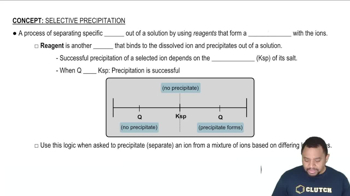
Selective Precipitation
Spectator Ions
Spectator ions are ions that do not participate in the actual chemical reaction and remain unchanged in the solution. In the reaction between Cd(NO3)2 and Na2S, the sodium ions (Na+) and nitrate ions (NO3-) are spectator ions, as they do not form a precipitate and remain in the solution after the reaction occurs.
Video consigliato:
Percorso guidato
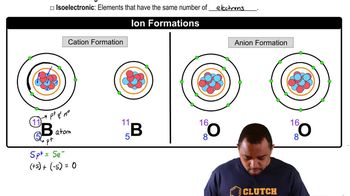
Ion Formation
Pratica correlata
Domanda del libro di testo
1379
views
1
rank
Domanda del libro di testo
A 1.248-g sample of limestone rock is pulverized and then treated with 30.00 mL of 1.035 M HCl solution. The excess acid then requires 11.56 mL of 1.010 M NaOH for neutralization. Calculate the percentage by mass of calcium carbonate in the rock, assuming that it is the only substance reacting with the HCl solution.
1098
views
Domanda del libro di testo
The accompanying photo shows the reaction between a solution of Cd(NO3)2 and one of Na2S. (d) Is this a redox reaction?
303
views
Domanda del libro di testo
Uranium hexafluoride, UF6, is processed to produce fuel for nuclear reactors and nuclear weapons. UF6 is made from the reaction of elemental uranium with ClF3, which also produces Cl2 as a by-product. b. Is this a metathesis reaction?
3
views
