
Ch.4 - Reactions in Aqueous Solution
Brown - Chemistry: The Central Science 15th Edition
Brown15th EditionChemistry: The Central ScienceISBN: 9780137542970Non è quello che usi tu?Cambia libro di testo
Capitolo 4, Problema 4

The concept of chemical equilibrium is very important. Which one of the following statements is the most correct way to think about equilibrium? (a) If a system is at equilibrium, nothing is happening. (b) If a system is at equilibrium, the rate of the forward reaction is equal to the rate of the back reaction. (c) If a system is at equilibrium, the product concentration is changing over time.

Guida verificata passo dopo passo
1
Understand that chemical equilibrium is a dynamic state where the concentrations of reactants and products remain constant over time.
Recognize that at equilibrium, the forward and reverse reactions continue to occur, but at equal rates, so there is no net change in concentrations.
Evaluate statement (a): It suggests that nothing is happening, which is incorrect because reactions are still occurring at equilibrium.
Evaluate statement (b): It correctly describes equilibrium as the point where the rate of the forward reaction equals the rate of the reverse reaction.
Evaluate statement (c): It incorrectly suggests that product concentration changes over time, which contradicts the definition of equilibrium.

Risposta video verificata per un problema simile:

Questa soluzione video è stata consigliata dai nostri tutor come utile per risolvere questo problema.
Durata del video:
2m

Concetti chiave

Ecco i concetti essenziali che devi comprendere per rispondere correttamente alla domanda.

Chemical Equilibrium

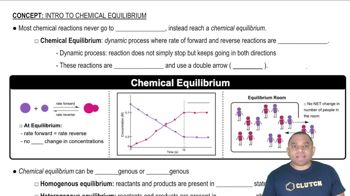
Chemical equilibrium occurs in a reversible reaction when the rates of the forward and reverse reactions are equal, resulting in constant concentrations of reactants and products over time. This state does not imply that the reactions have stopped; rather, they continue to occur at equal rates.
Video consigliato:
Percorso guidato
04:21
Chemical Equilibrium Concepts

Dynamic Nature of Equilibrium

Equilibrium is dynamic, meaning that even though the concentrations of reactants and products remain constant, the individual molecules are still reacting. This ongoing process is crucial for understanding that equilibrium is not a static state but a balance of continuous activity.
Video consigliato:
Percorso guidato
01:26
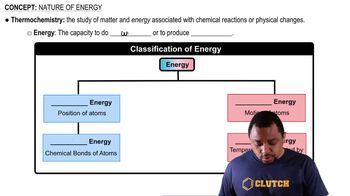
Nature of Energy

Equilibrium Constant

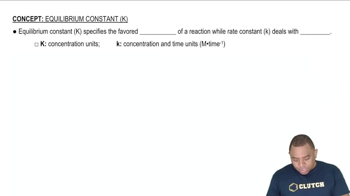
The equilibrium constant (K) quantifies the ratio of product concentrations to reactant concentrations at equilibrium, each raised to the power of their coefficients in the balanced equation. This constant provides insight into the position of equilibrium and the extent of the reaction, indicating whether products or reactants are favored.
Video consigliato:
Percorso guidato
01:14
Equilibrium Constant K
Pratica correlata
Domanda del libro di testo

You are presented with a white solid and told that due to careless labeling it is not clear if the substance is barium chloride, lead chloride, or zinc chloride. When you transfer the solid to a beaker and add water, the solid dissolves to give a clear solution. Next an Na2SO41aq2 solution is added and a white precipitate forms. What is the identity of the unknown white solid?

430
views
Domanda del libro di testo

Which of the following ions will always be a spectator ion in a precipitation reaction? (a) Cl- (b) NO3- (c) NH4+ (d) S2- (e) SO42-

2323
views
Domanda del libro di testo

Use the molecular representations shown here to classify each compound as a nonelectrolyte, a weak electrolyte, or a strong electrolyte (see Figure 4.6 for the element color scheme). (a)

709
views
Domanda del libro di testo

Which of the following schematic drawings best describes a solution of Li2SO4 in water (water molecules not shown for simplicity)?

1261
views
Domanda del libro di testo

Which of these statements is true?

a. If a compound is oxidized, it is gaining electrons.

b. If a base is neutralized, it is gaining protons.

c. Elements that are metals cannot be oxidized.

d. If hydrogen gas is generated in a reaction, it must be an acid–base reaction.

2
views
Domanda del libro di testo

Aqueous solutions of three different substances, AX, AY, and AZ, are represented by the three accompanying diagrams. Identify each substance as a strong electrolyte, a weak electrolyte, or a nonelectrolyte.

928
views