Would you expect that an anion would be physically closer to the oxygen or to the hydrogens of water molecules that surround it in solution?
Ch.4 - Reactions in Aqueous Solution

Brown15th EditionChemistry: The Central ScienceISBN: 9780137542970Non è quello che usi tu?Cambia libro di testo
Capitolo 4, Problema 15
We have learned in this chapter that many ionic solids dissolve in water as strong electrolytes; that is, as separated ions in solution. Which statement is most correct about this process? (a) Water is a strong acid and therefore is good at dissolving ionic solids. (b) Water is good at solvating ions because the hydrogen and oxygen atoms in water molecules bear partial charges. (c) The hydrogen and oxygen bonds of water are easily broken by ionic solids.
Guida verificata passo dopo passo1
Identify the nature of water as a solvent. Water is a polar molecule, meaning it has a partial positive charge on the hydrogen atoms and a partial negative charge on the oxygen atom.
Consider the role of water's polarity in dissolving ionic solids. The partial charges on water molecules can interact with the positive and negative ions in an ionic solid.
Evaluate statement (a): Water is not a strong acid; it is a neutral solvent. Therefore, this statement is incorrect.
Evaluate statement (b): The partial charges on the hydrogen and oxygen atoms in water make it effective at solvating ions, as these charges can stabilize the ions in solution.
Evaluate statement (c): The bonds within water molecules are not easily broken by ionic solids. Instead, water's ability to dissolve ionic solids is due to its polarity and ability to solvate ions.

Risposta video verificata per un problema simile:
Questa soluzione video è stata consigliata dai nostri tutor come utile per risolvere questo problema.
Durata del video:
1mConcetti chiave
Ecco i concetti essenziali che devi comprendere per rispondere correttamente alla domanda.
Ionic Compounds and Solubility
Ionic compounds consist of positively and negatively charged ions held together by strong electrostatic forces. When these compounds dissolve in water, the ionic bonds are overcome by the interactions with water molecules, allowing the ions to separate and disperse in solution. This process is essential for understanding how ionic solids behave in aqueous environments.
Video consigliato:
Percorso guidato
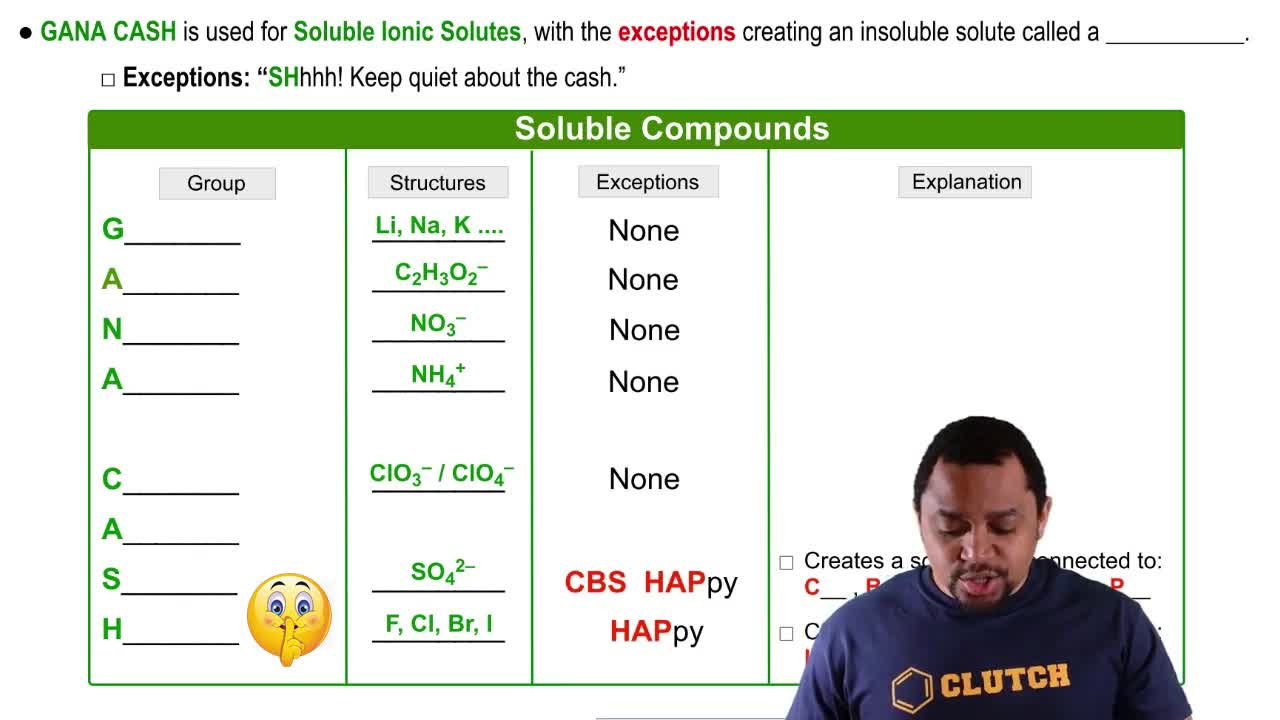
Soluble Ionic Solutes
Polarity of Water
Water is a polar molecule, meaning it has a partial positive charge on the hydrogen atoms and a partial negative charge on the oxygen atom. This polarity allows water molecules to interact effectively with charged ions, stabilizing them in solution through solvation. The ability of water to solvate ions is a key factor in its role as a solvent for ionic compounds.
Video consigliato:
Percorso guidato
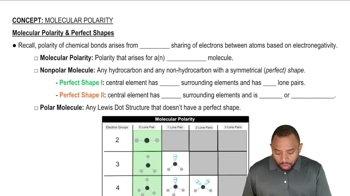
Molecular Polarity
Solvation Process
Solvation is the process by which solvent molecules surround and interact with solute ions or molecules. In the case of ionic solids dissolving in water, the water molecules surround the individual ions, effectively separating them from the solid lattice. This interaction is crucial for the dissolution of ionic compounds and is driven by the favorable energy changes associated with the formation of solute-solvent interactions.
Video consigliato:
Percorso guidato
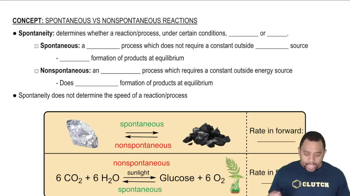
Spontaneity of Processes
Pratica correlata
Domanda del libro di testo
406
views
Domanda del libro di testo
State whether each of the following statements is true or false. Justify your answer in each case. (b) If you add a nonelectrolyte to an aqueous solution that already contains an electrolyte, the electrical conductivity will not change.
987
views
Domanda del libro di testo
State whether each of the following statements is true or false. Justify your answer in each case. (a) Electrolyte solutions conduct electricity because electrons are moving through the solution.
517
views
Domanda del libro di testo
Specify what ions are present in solution upon dissolving each of the following substances in water: c. (NH4)2SO4
2
views
Domanda del libro di testo
Specify what ions are present in solution upon dissolving each of the following substances in water: a. FeCl2
2
views