Identify the precipitate (if any) that forms when the following solutions are mixed, and write a balanced equation for each reaction. b. KOH and Cu(NO3)2
Ch.4 - Reactions in Aqueous Solution

Brown15th EditionChemistry: The Central ScienceISBN: 9780137542970Non è quello che usi tu?Cambia libro di testo
Capitolo 4, Problema 25c
Which ions remain in solution, unreacted, after each of the following pairs of solutions is mixed? (c) ammonium phosphate and calcium chloride
Guida verificata passo dopo passo1
Step 1: Write down the chemical formulas for the reactants. Ammonium phosphate is (NH4)3PO4 and calcium chloride is CaCl2.
Step 2: Predict the possible products of the reaction using the principle of 'cation-anion' exchange. The possible products are ammonium chloride (NH4Cl) and calcium phosphate (Ca3(PO4)2).
Step 3: Check the solubility rules to determine if any of the products will precipitate. According to the solubility rules, all ammonium salts (NH4+) are soluble, so ammonium chloride will not precipitate. However, most phosphate salts are insoluble, with some exceptions including salts of ammonium (NH4+). Therefore, calcium phosphate will precipitate.
Step 4: Since calcium phosphate precipitates, the calcium ions (Ca2+) from calcium chloride will react and will not remain in the solution. However, the chloride ions (Cl-) from calcium chloride will not react and will remain in the solution.
Step 5: Similarly, the phosphate ions (PO4^3-) from ammonium phosphate will react and will not remain in the solution. However, the ammonium ions (NH4+) from ammonium phosphate will not react and will remain in the solution.

Risposta video verificata per un problema simile:
Questa soluzione video è stata consigliata dai nostri tutor come utile per risolvere questo problema.
Durata del video:
7mConcetti chiave
Ecco i concetti essenziali che devi comprendere per rispondere correttamente alla domanda.
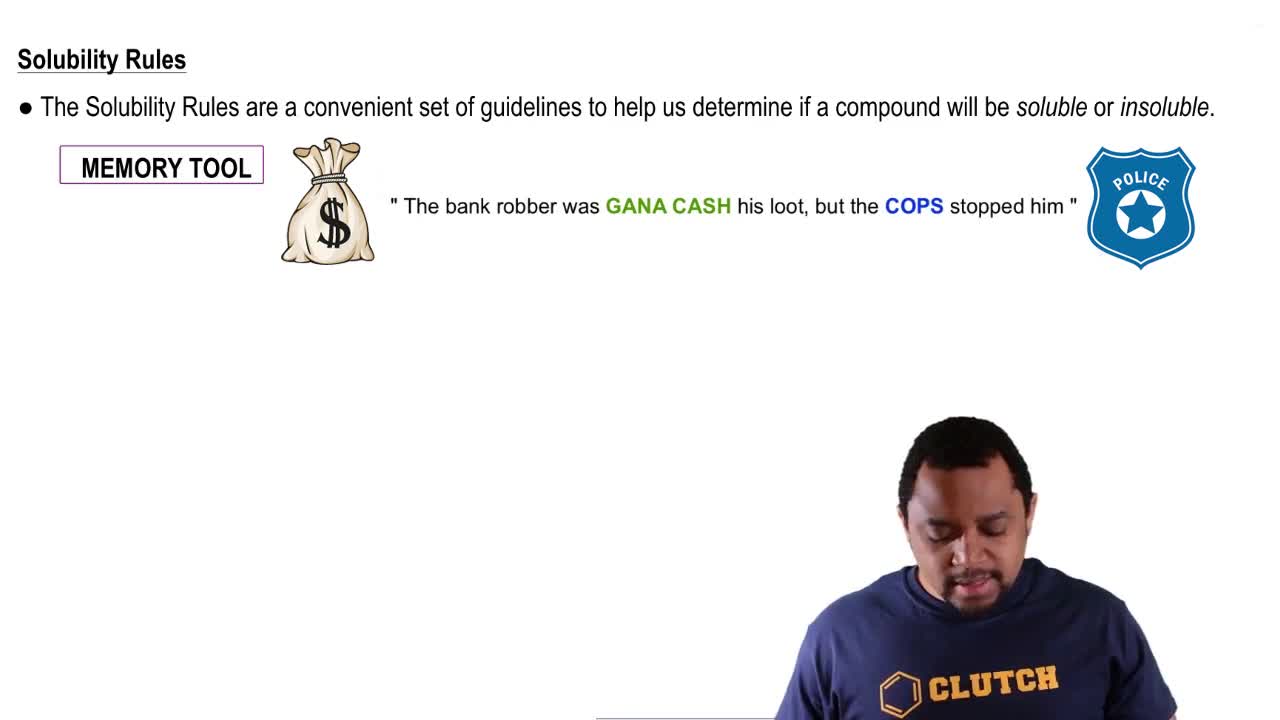
Solubility Rules
Solubility rules are guidelines that help predict whether a compound will dissolve in water. For example, most ammonium salts and phosphates are soluble, while many calcium salts can be insoluble. Understanding these rules is crucial for determining which ions remain in solution after mixing different ionic compounds.
Video consigliato:
Percorso guidato
Solubility Rules
Ionic Compounds and Dissociation
Ionic compounds dissociate into their constituent ions when dissolved in water. For instance, ammonium phosphate dissociates into ammonium (NH4+) and phosphate (PO4^3-) ions, while calcium chloride dissociates into calcium (Ca^2+) and chloride (Cl-) ions. Recognizing how these compounds break apart in solution is essential for analyzing the resulting mixture.
Video consigliato:
Percorso guidato
Ionic Compounds Naming
Precipitation Reactions
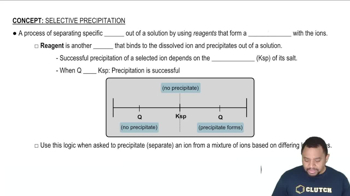
A precipitation reaction occurs when two soluble ionic compounds react to form an insoluble compound, or precipitate. In the case of mixing ammonium phosphate and calcium chloride, calcium phosphate may precipitate out of solution. Identifying which ions remain unreacted involves understanding the potential for precipitation based on solubility product constants.
Video consigliato:
Percorso guidato
Selective Precipitation
Pratica correlata
Domanda del libro di testo
3
views
Domanda del libro di testo
Write balanced net ionic equations for the reactions that occur in each of the following cases. Identify the spectator ion or ions in each reaction. a. Cr2(SO4)3(𝑎𝑞)+(NH4)2CO3(𝑎𝑞)⟶
6
views
Domanda del libro di testo
Write balanced net ionic equations for the reactions that occur in each of the following cases. Identify the spectator ion or ions in each reaction. c. Fe(NO3)2(𝑎𝑞)+KOH(𝑎𝑞)⟶
2
views
Domanda del libro di testo
Which ions remain in solution, unreacted, after each of the following pairs of solutions is mixed? (a) potassium carbonate and magnesium sulfate
646
views
Domanda del libro di testo
Will precipitation occur when the following solutions are mixed? If so, write a balanced chemical equation for the reaction. c. FeSO4 and Pb(NO3)2
3
views