Ch.4 - Reactions in Aqueous Solution
Brown - Chemistry: The Central Science 15th Edition
Brown15th EditionChemistry: The Central ScienceISBN: 9780137542970Non è quello che usi tu?Cambia libro di testo
Capitolo 4, Problema 40b

Write the balanced molecular and net ionic equations for each of the following neutralization reactions: (b) Solid chromium(III) hydroxide reacts with nitrous acid.

Guida verificata passo dopo passo
1
Write the formulas for the reactants: Solid chromium(III) hydroxide is Cr(OH)₃ and nitrous acid is HNO₂.
Combine the reactants in a balanced chemical equation. Since Cr(OH)₃ is a base and HNO₂ is an acid, they will react in a typical acid-base neutralization to form water and a salt. The salt in this case would be chromium(III) nitrite, Cr(NO₂)₃.
Balance the equation by ensuring that the number of atoms for each element is the same on both sides of the equation. This involves adjusting the coefficients of the reactants and products.
Write the total ionic equation by breaking all soluble compounds into their ions. Chromium(III) hydroxide is slightly soluble, so it will mostly remain as Cr(OH)₃(s). Nitrous acid is a weak acid but can be ionized as H⁺ and NO₂⁻.
Identify and remove the spectator ions (ions that appear on both sides of the equation in the same form) to write the net ionic equation. In this case, the net ionic equation will involve the reaction of H⁺ ions with OH⁻ ions from Cr(OH)₃ to form water, and the formation of the chromium(III) nitrite precipitate.

Risposta video verificata per un problema simile:

Questa soluzione video è stata consigliata dai nostri tutor come utile per risolvere questo problema.
Durata del video:
7m

Concetti chiave

Ecco i concetti essenziali che devi comprendere per rispondere correttamente alla domanda.

Neutralization Reactions

Neutralization reactions occur when an acid reacts with a base to produce water and a salt. In this context, chromium(III) hydroxide acts as a base, while nitrous acid serves as the acid. The general form of a neutralization reaction can be represented as: acid + base → salt + water.
Video consigliato:
Percorso guidato
05:56
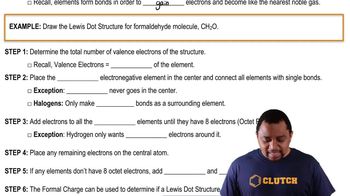
Lewis Dot Structures: Neutral Compounds

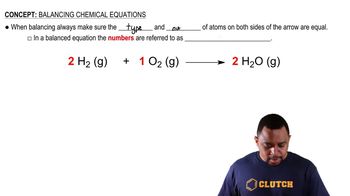
Balancing Chemical Equations

Balancing chemical equations is essential to ensure that the number of atoms of each element is conserved in a reaction. This involves adjusting the coefficients of the reactants and products so that they match. For the given reaction, one must account for the chromium, oxygen, hydrogen, and nitrogen atoms to achieve a balanced equation.
Video consigliato:
Percorso guidato
01:32
Balancing Chemical Equations

Net Ionic Equations

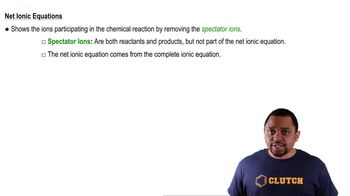
Net ionic equations represent the actual chemical species that participate in a reaction, excluding spectator ions that do not change during the reaction. To derive the net ionic equation, one must first write the complete ionic equation and then eliminate the ions that appear unchanged on both sides. This focuses on the essential components of the reaction.
Video consigliato:
Percorso guidato
00:51
Net Ionic Equations