
Ch.5 - Thermochemistry
Brown - Chemistry: The Central Science 15th Edition
Brown15th EditionChemistry: The Central ScienceISBN: 9780137542970Non è quello che usi tu?Cambia libro di testo
Capitolo 5, Problema 76a

Using values from Appendix C, calculate the value of H for each of the following reactions: (a) NiO(s) + 2 HCl(g) → NiCl2(s) + H2O(g)

Guida verificata passo dopo passo
1
Identify the standard enthalpy of formation (\( \Delta H_f^\circ \)) for each compound involved in the reaction from Appendix C.
Write the balanced chemical equation: \( \text{NiO(s)} + 2 \text{HCl(g)} \rightarrow \text{NiCl}_2\text{(s)} + \text{H}_2\text{O(g)} \).
Apply Hess's Law to calculate the enthalpy change (\( \Delta H \)) for the reaction using the formula: \( \Delta H = \sum \Delta H_f^\circ \text{(products)} - \sum \Delta H_f^\circ \text{(reactants)} \).
Substitute the \( \Delta H_f^\circ \) values for each product and reactant into the formula.
Perform the arithmetic operations to find the \( \Delta H \) for the reaction.

Risposta video verificata per un problema simile:

Questa soluzione video è stata consigliata dai nostri tutor come utile per risolvere questo problema.
Durata del video:
2m

Concetti chiave

Ecco i concetti essenziali che devi comprendere per rispondere correttamente alla domanda.

Enthalpy Change (ΔH)

Enthalpy change (ΔH) is the heat content change of a system at constant pressure. It indicates whether a reaction is exothermic (releases heat, ΔH < 0) or endothermic (absorbs heat, ΔH > 0). Calculating ΔH for a reaction often involves using standard enthalpy values from tables, which represent the enthalpy of formation for various substances.
Video consigliato:
Percorso guidato
02:34
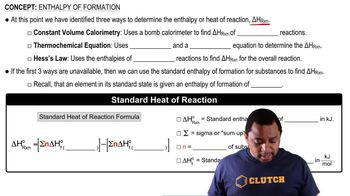
Enthalpy of Formation

Standard Enthalpy of Formation

The standard enthalpy of formation (ΔH°f) is the change in enthalpy when one mole of a compound is formed from its elements in their standard states. These values are crucial for calculating the overall enthalpy change of a reaction using Hess's law, which states that the total enthalpy change is the sum of the enthalpy changes for individual steps.
Video consigliato:
Percorso guidato
02:34
Enthalpy of Formation

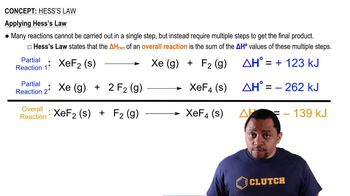
Hess's Law

Hess's Law states that the total enthalpy change for a reaction is the same, regardless of the number of steps or the pathway taken. This principle allows chemists to calculate the enthalpy change for complex reactions by breaking them down into simpler steps for which enthalpy values are known, facilitating the calculation of ΔH for the overall reaction.
Video consigliato:
Pratica correlata
Domanda del libro di testo

Write balanced equations that describe the formation of the following compounds from elements in their standard states, and then look up the standard enthalpy of formation for each substance in Appendix C: (a) NH4NO3(s)

1
views
Domanda del libro di testo

Calcium carbide (CaC2) reacts with water to form acetylene (C2H2) and Ca(OH)2. From the following enthalpy of reaction data and data in Appendix C, calculate H°f for CaC2(s): CaC2(s) + 2 H2O(l) → Ca(OH2)(s) + C2H2(g) ΔH° = -127.2 kJ

972
views
Domanda del libro di testo

Gasoline is composed primarily of hydrocarbons, including many with eight carbon atoms, called octanes. One of the cleanest–burning octanes is a compound called 2,3,4- trimethylpentane, which has the following structural formula: The complete combustion of one mole of this compound to CO2(g) and H2O(g) leads to ΔH° = -5064.9 kJ. (b) By using the information in this problem and data in Table 5.3, calculate H°f for 2,3,4-trimethylpentane.

1204
views
Domanda del libro di testo

Complete combustion of 1 mol of acetone (C3H6O) liberates 1790 kJ: C3H6O(l) + 4 O2(g) → 3 CO2(g) + 3 H2O(l) ΔH° = -1790 kJ Using this information together with the standard enthalpies of formation of O2(g), CO2(g), and H2O(l) from Appendix C, calculate the standard enthalpy of formation of acetone.

2665
views
Domanda del libro di testo

Many portable gas heaters and grills use propane, C3H8(g), as a fuel. Using standard enthalpies of formation, calculate the quantity of heat produced when 10.0 g of propane is completely combusted in air under standard conditions.

4
views