
Ozone, O3(g), is a form of elemental oxygen that plays an important role in the absorption of ultraviolet radiation in the stratosphere. It decomposes to O2(g) at room temperature and pressure according to the following reaction: 2 O3(g) → 3 O2(g) ΔH= -284.6 kJ b. Which has the higher enthalpy under these conditions, 2 O3(g) or 3 O2(g)?
Ch.5 - Thermochemistry

Brown15th EditionChemistry: The Central ScienceISBN: 9780137542970Non è quello che usi tu?Cambia libro di testo
Capitolo 5, Problema 42b
Without referring to tables, predict which of the following has the higher enthalpy in each case: (b) 2 mol of hydrogen atoms or 1 mol of H2
Guida verificata passo dopo passo1
Understand that enthalpy is a measure of the total energy of a thermodynamic system, often related to the energy required to break or form chemical bonds.
Recognize that breaking chemical bonds requires energy, while forming bonds releases energy.
Consider the diatomic hydrogen molecule (H2), which consists of two hydrogen atoms bonded together. The formation of this bond releases energy, resulting in a lower enthalpy for the molecule compared to separate atoms.
Compare the two scenarios: 2 mol of hydrogen atoms are unbonded and thus have higher energy (enthalpy) compared to 1 mol of H2, where the atoms are bonded and have lower energy.
Conclude that 2 mol of hydrogen atoms have a higher enthalpy than 1 mol of H2 because the energy required to keep the atoms separate is greater than the energy of the bonded molecule.

Risposta video verificata per un problema simile:
Questa soluzione video è stata consigliata dai nostri tutor come utile per risolvere questo problema.
Durata del video:
1mConcetti chiave
Ecco i concetti essenziali che devi comprendere per rispondere correttamente alla domanda.
Enthalpy
Enthalpy is a thermodynamic property that represents the total heat content of a system. It is defined as the sum of the internal energy and the product of pressure and volume. In chemical reactions, changes in enthalpy (ΔH) indicate whether a reaction is exothermic (releases heat) or endothermic (absorbs heat). Understanding enthalpy is crucial for predicting the stability and energy changes associated with different molecular forms.
Video consigliato:
Percorso guidato
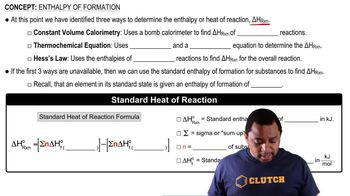
Enthalpy of Formation
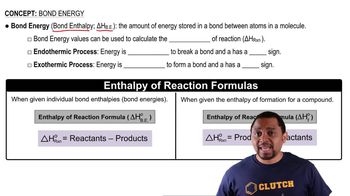
Bond Energy
Bond energy is the amount of energy required to break a bond between two atoms in a molecule. In the case of hydrogen, the H-H bond in H2 is a covalent bond that holds two hydrogen atoms together. When comparing 2 moles of hydrogen atoms to 1 mole of H2, it is important to consider that breaking the H-H bond requires energy, which affects the overall enthalpy of the system.
Video consigliato:
Percorso guidato
Bond Energy
Molecular Stability
Molecular stability refers to the tendency of a molecule to maintain its structure and resist decomposition. Molecules like H2 are generally more stable than individual atoms due to the presence of covalent bonds that lower the system's energy. In this context, the stability of H2 compared to free hydrogen atoms influences the enthalpy, as stable molecules typically have lower enthalpy than their constituent atoms.
Video consigliato:
Percorso guidato
Intepreting the Band of Stability
Pratica correlata
Domanda del libro di testo
5
views
Domanda del libro di testo
The decomposition of Ca(OH)2 into CaO(s) and H2O at constant pressure requires the addition of 109 kJ of heat per mole of Ca(OH)2 . b. Draw an enthalpy diagram for the reaction.
2
views
Domanda del libro di testo
Without referring to tables, predict which of the following has the higher enthalpy in each case: (c) 1 mol H2(g) and 0.5 mol O2(g) at 25 °C or 1 mol H2O(g) at 25 °C
2
views
Domanda del libro di testo
Consider the following reaction: 2 CH3OH(g) → 2 CH4(g) + O2(g) ΔH = +252.8 kJ (b) Calculate the amount of heat transferred when 24.0 g of CH3OH(g) is decomposed by this reaction at constant pressure.
719
views
1
rank
Domanda del libro di testo
Without referring to tables, predict which of the following has the higher enthalpy in each case: (a) 1 mol CO2(s) or 1 mol CO2(g) at the same temperature
3
views
