Ch.5 - Thermochemistry
Brown - Chemistry: The Central Science 15th Edition
Brown15th EditionChemistry: The Central ScienceISBN: 9780137542970Non è quello che usi tu?Cambia libro di testo
Capitolo 5, Problema 58a

A 1.800-g sample of phenol (C6H5OH) was burned in a bomb calorimeter whose total heat capacity is 11.66 kJ/°C. The temperature of the calorimeter plus contents increased from 21.36 to 26.37 °C. a. Write a balanced chemical equation for the bomb calorimeter reaction.

Guida verificata passo dopo passo
1
Identify the chemical formula for phenol, which is C_6H_5OH.
Write the general form of a combustion reaction: C_xH_yO_z + O_2 -> CO_2 + H_2O.
Balance the carbon atoms: C_6H_5OH + O_2 -> 6CO_2 + H_2O.
Balance the hydrogen atoms: C_6H_5OH + O_2 -> 6CO_2 + 3H_2O.
Balance the oxygen atoms by adjusting the O_2 molecules: C_6H_5OH + 7.5O_2 -> 6CO_2 + 3H_2O.

Risposta video verificata per un problema simile:

Questa soluzione video è stata consigliata dai nostri tutor come utile per risolvere questo problema.
Durata del video:
2m

Concetti chiave

Ecco i concetti essenziali che devi comprendere per rispondere correttamente alla domanda.

Combustion Reaction

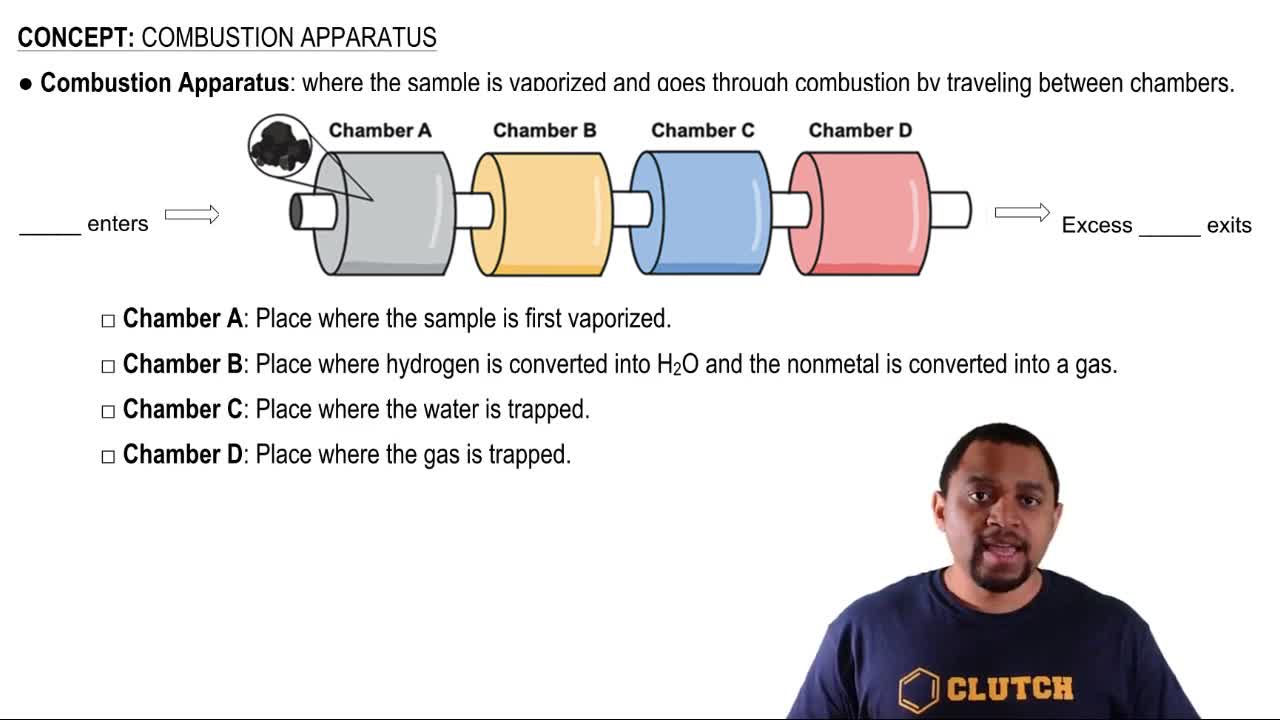
A combustion reaction is a chemical process in which a substance (typically a hydrocarbon) reacts with oxygen to produce carbon dioxide, water, and energy. In the case of phenol (C6H5OH), the balanced equation will show phenol reacting with oxygen to yield carbon dioxide and water, illustrating the transformation of chemical energy into thermal energy.
Video consigliato:
Percorso guidato
02:24
Combustion Apparatus

Calorimetry

Calorimetry is the science of measuring the heat of chemical reactions or physical changes. In this scenario, a bomb calorimeter is used to measure the heat released during the combustion of phenol. The temperature change observed in the calorimeter allows for the calculation of the heat of combustion, which is essential for understanding the energy changes involved in the reaction.
Video consigliato:
Percorso guidato
00:50
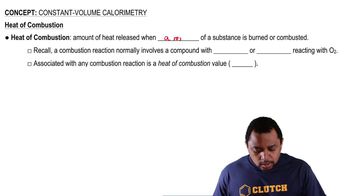
Constant-Volume Calorimetry

Heat Capacity

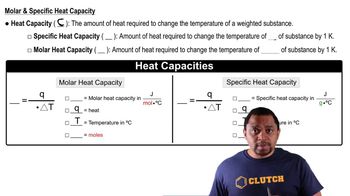
Heat capacity is the amount of heat required to change the temperature of a substance by one degree Celsius. In this question, the total heat capacity of the bomb calorimeter is given as 11.66 kJ/°C, which indicates how much energy is absorbed by the calorimeter for each degree of temperature increase. This value is crucial for calculating the total heat released during the combustion of phenol based on the observed temperature change.
Video consigliato:
Pratica correlata
Domanda del libro di testo

(b) Is this process endothermic or exothermic?

487
views

Domanda del libro di testo

A 1.800-g sample of phenol (C6H5OH) was burned in a bomb calorimeter whose total heat capacity is 11.66 kJ/°C. The temperature of the calorimeter plus contents increased from 21.36 to 26.37 °C. b. What is the heat of combustion per gram of phenol?

2
views
Domanda del libro di testo

Under constant-volume conditions, the heat of combustion of benzoic acid (C6H5COOH) is 26.38 kJ/g. A 2.760-g sample of benzoic acid is burned in a bomb calorimeter. The temperature of the calorimeter increases from 21.60 to 29.93 °C. c. Suppose that in changing samples, a portion of the water in the calorimeter were lost. In what way, if any, would this change the heat capacity of the calorimeter?

2
views
Domanda del libro di testo

A 2.200-g sample of quinone (C6H4O2) is burned in a bomb calorimeter whose total heat capacity is 7.854 kJ/°C. The temperature of the calorimeter increases from 23.44 to 30.57 °C. b. What is the heat of combustion per mole of quinone?

3
views
Domanda del libro di testo

A 2.200-g sample of quinone (C6H4O2) is burned in a bomb calorimeter whose total heat capacity is 7.854 kJ/°C. The temperature of the calorimeter increases from 23.44 to 30.57 °C. (a) What is the heat of combustion per gram of quinone?

2
views
1
rank
Domanda del libro di testo

Consider the following hypothetical reactions: A → B ΔH = +30 kJ B → C ΔH = +60 kJ (b) Construct an enthalpy diagram for substances A, B, and C, and show how Hess's law applies.

3
views