The diagram shows four states of a system, each with different internal energy, E. (c) Write an expression for the difference in energy between State C and State D.
Ch.5 - Thermochemistry

Brown15th EditionChemistry: The Central ScienceISBN: 9780137542970Non è quello che usi tu?Cambia libro di testo
Capitolo 5, Problema 3a
a. Does the accompanying energy diagram represent an increase or decrease in the internal energy of the system?
Guida verificata passo dopo passo1
Identify the initial and final energy levels on the energy diagram.
Determine whether the final energy level is higher or lower than the initial energy level.
If the final energy level is higher than the initial energy level, the internal energy of the system has increased.
If the final energy level is lower than the initial energy level, the internal energy of the system has decreased.
Conclude whether there is an increase or decrease in the internal energy based on the comparison of initial and final energy levels.

Risposta video verificata per un problema simile:
Questa soluzione video è stata consigliata dai nostri tutor come utile per risolvere questo problema.
Durata del video:
50sConcetti chiave
Ecco i concetti essenziali che devi comprendere per rispondere correttamente alla domanda.
Internal Energy
Internal energy is the total energy contained within a system, encompassing both kinetic and potential energy of the particles. It is a state function, meaning it depends only on the current state of the system, not on how it reached that state. Changes in internal energy can occur due to heat transfer or work done on or by the system.
Video consigliato:
Percorso guidato
Internal Energy
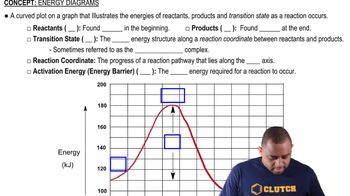
Energy Diagrams
Energy diagrams visually represent the energy changes that occur during a chemical reaction or physical process. They typically show the energy of the system on the vertical axis and the progress of the reaction on the horizontal axis. An increase in internal energy is indicated by a rise in the diagram, while a decrease is shown by a drop.
Video consigliato:
Percorso guidato
Energy Diagrams
First Law of Thermodynamics
The First Law of Thermodynamics states that energy cannot be created or destroyed, only transformed from one form to another. This principle implies that any change in the internal energy of a system is equal to the heat added to the system minus the work done by the system. Understanding this law is crucial for interpreting energy diagrams and determining whether internal energy increases or decreases.
Video consigliato:
Percorso guidato
First Law of Thermodynamics
Pratica correlata
Domanda del libro di testo
1106
views
Domanda del libro di testo
The accompanying photo shows a pipevine swallowtail caterpillar climbing up a twig. (a) As the caterpillar climbs, its potential energy is increasing. What source of energy has been used to effect this change in potential energy?
371
views
Domanda del libro di testo
The contents of the closed box in each of the following illustrations represent a system, and the arrows show the changes to the system during some process. The lengths of the arrows represent the relative magnitudes of q and w. (a) Which of these processes is endothermic?
812
views
2
rank
Domanda del libro di testo
The diagram shows four states of a system, each with different internal energy, E. (a) Which of the states of the system has the greatest internal energy?
443
views
1
rank