
Ch.5 - Thermochemistry
Brown - Chemistry: The Central Science 15th Edition
Brown15th EditionChemistry: The Central ScienceISBN: 9780137542970Non è quello che usi tu?Cambia libro di testo
Capitolo 5, Problema 38

A gas is confined to a cylinder under constant atmospheric pressure, as illustrated in Figure 5.4. When 0.49 kJ of heat is added to the gas, it expands and does 214 J of work on the surroundings. What are the values of H and E for this process?

Guida verificata passo dopo passo
1
Identify the given values: the heat added to the system \( q = 0.49 \text{ kJ} \) and the work done by the system \( w = 214 \text{ J} \).
Convert all units to the same system for consistency. Since \( q \) is given in kJ, convert \( w \) from J to kJ: \( 1 \text{ kJ} = 1000 \text{ J} \).
Use the first law of thermodynamics, which states \( \Delta E = q - w \), to find the change in internal energy \( \Delta E \).
Calculate the change in enthalpy \( \Delta H \) using the relationship \( \Delta H = \Delta E + P\Delta V \). Since the process occurs at constant pressure, \( \Delta H = q \).
Substitute the known values into the equations to find \( \Delta E \) and \( \Delta H \).

Risposta video verificata per un problema simile:

Questa soluzione video è stata consigliata dai nostri tutor come utile per risolvere questo problema.

Concetti chiave

Ecco i concetti essenziali che devi comprendere per rispondere correttamente alla domanda.

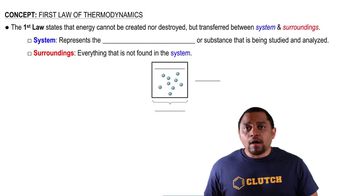
First Law of Thermodynamics

The First Law of Thermodynamics states that energy cannot be created or destroyed, only transformed from one form to another. In the context of a gas expanding in a cylinder, the internal energy change (ΔE) of the system is equal to the heat added to the system (q) minus the work done by the system (w) on the surroundings, expressed as ΔE = q - w.
Video consigliato:
Percorso guidato
01:18
First Law of Thermodynamics

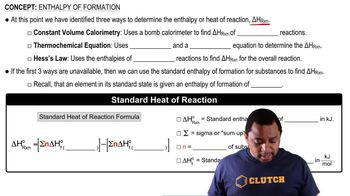
Enthalpy (H)

Enthalpy is a thermodynamic quantity that represents the total heat content of a system at constant pressure. It is defined as H = E + PV, where E is the internal energy, P is the pressure, and V is the volume. In processes occurring at constant pressure, the change in enthalpy (ΔH) can be directly related to the heat exchanged with the surroundings.
Video consigliato:
Percorso guidato
02:34
Enthalpy of Formation

Work Done by a Gas

In thermodynamics, the work done by a gas during expansion is calculated as the product of pressure and the change in volume (w = PΔV). When a gas expands against a constant external pressure, it does work on the surroundings, which must be accounted for when calculating changes in internal energy and enthalpy.
Video consigliato:
Percorso guidato
01:52
Work Function Calculation Example