

The Sun supplies about 1.0 kilowatt of energy for each square meter of surface area (1.0 kW/m2, where a watt=1 J/s). Plants produce the equivalent of about 0.20 g of sucrose (C12H22O11) per hour per square meter. Assuming that the sucrose is produced as follows, calculate the percentage of sunlight used to produce sucrose. 12 CO2(g) + 11 H2O(l) → C12H22O11 + 12 O2(g) H = 5645 kJ
Ch.5 - Thermochemistry

Brown15th EditionChemistry: The Central ScienceISBN: 9780137542970Non è quello che usi tu?Cambia libro di testo
Capitolo 5, Problema 121b
At 20 °C (approximately room temperature) the average velocity of N2 molecules in air is 1050 mph. (b) What is the kinetic energy (in J) of an N2 molecule moving at this speed?
Guida verificata passo dopo passo1
Convert the velocity of the N2 molecule from miles per hour (mph) to meters per second (m/s) using the conversion factor: 1 mph = 0.44704 m/s.
Calculate the mass of an N2 molecule. The molecular weight of N2 is approximately 28 g/mol. Convert this mass to kilograms (kg) by using the conversion factor: 1 g = 0.001 kg. Then, use Avogadro's number (6.022 \(\times\) 10^{23} molecules/mol) to find the mass of one molecule.
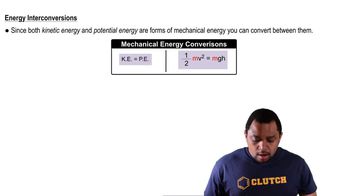
Use the kinetic energy formula: KE = \(\frac{1}{2}\)mv^2, where 'm' is the mass of the molecule in kg and 'v' is the velocity in m/s.
Plug the values of 'm' and 'v' into the kinetic energy formula to calculate the kinetic energy of the N2 molecule.
Ensure the final kinetic energy value is in Joules (J), as this is the standard unit for energy in the International System of Units (SI).

Risposta video verificata per un problema simile:
Questa soluzione video è stata consigliata dai nostri tutor come utile per risolvere questo problema.
Durata del video:
4mConcetti chiave
Ecco i concetti essenziali che devi comprendere per rispondere correttamente alla domanda.
Kinetic Energy
Kinetic energy is the energy possessed by an object due to its motion, calculated using the formula KE = 0.5 * m * v², where m is the mass of the object and v is its velocity. For gas molecules like N₂, this concept is crucial for understanding how speed translates into energy at the molecular level.
Video consigliato:
Percorso guidato
Kinetic & Potential Energy
Molecular Mass
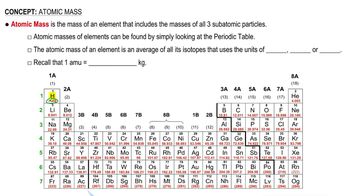
The molecular mass of a substance is the mass of a single molecule, typically expressed in atomic mass units (amu). For nitrogen (N₂), the molecular mass is approximately 28 amu, which is essential for calculating the kinetic energy of an individual N₂ molecule when given its velocity.
Video consigliato:
Percorso guidato
Atomic Mass
Conversion of Units
In physics and chemistry, it is often necessary to convert units to ensure consistency in calculations. In this case, converting the speed from miles per hour (mph) to meters per second (m/s) is essential for using standard SI units in the kinetic energy formula, allowing for accurate energy calculations.
Video consigliato:
Percorso guidato
Conversion Factors
Pratica correlata
Domanda del libro di testo
3
views
Domanda del libro di testo
Consider two solutions, the first being 50.0 mL of 1.00 M CuSO4 and the second 50.0 mL of 2.00 M KOH. When the two solutions are mixed in a constant-pressure calorimeter, a precipitate forms and the temperature of the mixture rises from 21.5 to 27.7 °C. (a) Before mixing, how many grams of Cu are present in the solution of CuSO4?
980
views
Domanda del libro di testo
Depending on their specific usage, fuels are judged in part on energy released per unit volume and energy released per unit mass. Three prospective fuels are listed in the following table, along with their densities and molar enthalpies of combustion.
a. Rank the three fuels according to their enthalpy produced per gram.
b. Rank them according to their enthalpy produced per cm3:
3
views
