Ch.5 - Thermochemistry
Brown - Chemistry: The Central Science 15th Edition
Brown15th EditionChemistry: The Central ScienceISBN: 9780137542970Non è quello che usi tu?Cambia libro di testo
Capitolo 5, Problema 48d

Consider the decomposition of liquid benzene, C6H6(l), to gaseous acetylene, C2H2(g): C6H6(l) → 3 C2H2(g) ΔH = +630 kJ (d) If C6H6(g) were consumed instead of C6H6(l), would you expect the magnitude of ΔH to increase, decrease, or stay the same? Explain.

Guida verificata passo dopo passo
1
Identify the phase change involved in the reaction. In the original reaction, benzene is in the liquid phase (C6H6(l)). If it were in the gaseous phase (C6H6(g)), this introduces a phase change from liquid to gas.
Recall that converting a substance from liquid to gas requires energy, known as the heat of vaporization. This energy is absorbed by the substance to overcome intermolecular forces.
Understand that the heat of reaction (ΔH) for a process includes all energy changes, including phase changes. If benzene starts as a gas instead of a liquid, the energy required for vaporization is not needed in the reaction pathway.
Consider how the absence of the heat of vaporization in the reaction pathway would affect the overall ΔH. Since the vaporization step (which absorbs energy) is omitted, the total energy change for the reaction would be less positive.
Conclude that if C6H6(g) were consumed instead of C6H6(l), the magnitude of ΔH would decrease because the reaction would not need to absorb the additional energy required for vaporizing liquid benzene.

Risposta video verificata per un problema simile:

Questa soluzione video è stata consigliata dai nostri tutor come utile per risolvere questo problema.
Durata del video:
2m

Concetti chiave

Ecco i concetti essenziali che devi comprendere per rispondere correttamente alla domanda.

Enthalpy Change (ΔH)

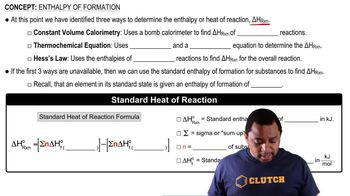
Enthalpy change (ΔH) is a measure of the heat content of a system at constant pressure. It indicates whether a reaction is exothermic (releases heat, ΔH < 0) or endothermic (absorbs heat, ΔH > 0). In this case, the positive ΔH of +630 kJ signifies that the decomposition of liquid benzene into gaseous acetylene is an endothermic process, requiring energy input.
Video consigliato:
Percorso guidato
02:34
Enthalpy of Formation

Phase Changes and Energy

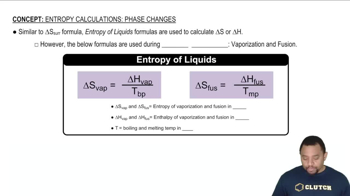
The phase of a substance significantly affects its energy content. Transitioning from a liquid to a gas requires energy to overcome intermolecular forces, which is reflected in the enthalpy change. If benzene is in the gaseous state, it has already absorbed energy to vaporize, potentially altering the overall energy dynamics of the reaction compared to starting with liquid benzene.
Video consigliato:
Percorso guidato
01:46
Entropy in Phase Changes

Reaction Pathway and Thermodynamics

The thermodynamic properties of a reaction can vary based on the initial and final states of the reactants. The pathway taken during a reaction, including the states of matter involved, can influence the total energy change. If gaseous benzene is consumed instead of liquid, the energy required for the reaction may differ, potentially leading to a different ΔH value, depending on the energy already present in the gaseous state.
Video consigliato:
Percorso guidato
01:18
First Law of Thermodynamics