

Ch.5 - Thermochemistry
Brown - Chemistry: The Central Science 15th Edition
Brown15th EditionChemistry: The Central ScienceISBN: 9780137542970Non è quello che usi tu?Cambia libro di testo
Capitolo 5, Problema 44d

Consider the following reaction: 2 CH3OH(g) → 2 CH4(g) + O2(g) ΔH = +252.8 kJ (d) How many kilojoules of heat are released when 38.5 g of CH4(g) reacts completely with O2(g) to form CH3OH(g) at constant pressure?

Guida verificata passo dopo passo
1
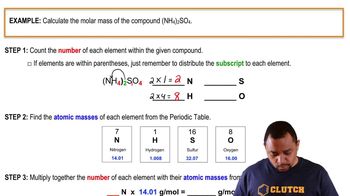
First, determine the molar mass of CH4 (methane) by adding the atomic masses of carbon (C) and hydrogen (H). The molar mass of C is approximately 12.01 g/mol and H is approximately 1.01 g/mol. Since CH4 has one carbon and four hydrogens, its molar mass is 12.01 g/mol + (4 imes 1.01 g/mol) = 16.05 g/mol.
Next, calculate the number of moles of CH4 by dividing the given mass of CH4 by its molar mass. Use the formula: Number of moles = Mass (g) / Molar mass (g/mol).
According to the stoichiometry of the reverse reaction, 2 moles of CH4 produce 2 moles of CH3OH and release 252.8 kJ of heat. Therefore, calculate the heat released per mole of CH4 by dividing the total heat change by the number of moles of CH4 involved in the reaction.
Multiply the number of moles of CH4 calculated in step 2 by the heat released per mole of CH4 (from step 3) to find the total heat released when 38.5 g of CH4 reacts.
Since the reaction is exothermic (releases heat), ensure the sign of the heat released is negative, indicating that energy is being released by the system.

Risposta video verificata per un problema simile:

Questa soluzione video è stata consigliata dai nostri tutor come utile per risolvere questo problema.
Durata del video:
3m

Concetti chiave

Ecco i concetti essenziali che devi comprendere per rispondere correttamente alla domanda.

Stoichiometry

Stoichiometry is the calculation of reactants and products in chemical reactions based on the balanced chemical equation. It allows us to determine the amount of substance consumed or produced in a reaction. In this case, we need to use the stoichiometric coefficients from the balanced equation to relate the moles of CH4 produced to the moles of CH3OH formed.
Video consigliato:
Percorso guidato
01:16
Stoichiometry Concept

Enthalpy Change (ΔH)

Enthalpy change (ΔH) is a measure of the heat content of a system at constant pressure. A positive ΔH indicates that the reaction is endothermic, meaning it absorbs heat. In this question, the ΔH value of +252.8 kJ indicates that this amount of energy is required to convert CH3OH into CH4 and O2, which will help us calculate the heat released when CH4 reacts to form CH3OH.
Video consigliato:
Percorso guidato
02:34
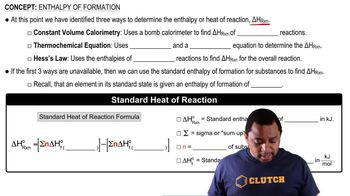
Enthalpy of Formation

Molar Mass and Heat Calculations

Molar mass is the mass of one mole of a substance, typically expressed in grams per mole. To find out how much heat is released when a certain mass of CH4 reacts, we first convert grams of CH4 to moles using its molar mass. Then, we can use the stoichiometry of the reaction and the enthalpy change to calculate the total heat released during the reaction.
Video consigliato:
Percorso guidato
03:12
Molar Mass Calculation Example