Ch.5 - Thermochemistry
Brown - Chemistry: The Central Science 15th Edition
Brown15th EditionChemistry: The Central ScienceISBN: 9780137542970Non è quello che usi tu?Cambia libro di testo
Capitolo 5, Problema 31

During a normal breath, our lungs expand about 0.50 L against an external pressure of 1.0 atm. How much work is involved in this process (in J)?

Guida verificata passo dopo passo
1
Identify the formula for work done by a gas during expansion: \( w = -P_{\text{ext}} \Delta V \), where \( w \) is work, \( P_{\text{ext}} \) is the external pressure, and \( \Delta V \) is the change in volume.
Convert the volume change from liters to cubic meters, since 1 L = 0.001 m³. Thus, \( \Delta V = 0.50 \text{ L} = 0.50 \times 0.001 \text{ m}^3 \).
Use the given external pressure \( P_{\text{ext}} = 1.0 \text{ atm} \). Convert this pressure to pascals (Pa) using the conversion factor: 1 atm = 101325 Pa.
Substitute the values into the work formula: \( w = - (101325 \text{ Pa}) \times (0.50 \times 0.001 \text{ m}^3) \).
Calculate the work \( w \) in joules (J), keeping in mind that the negative sign indicates work done by the system (lungs) on the surroundings.

Risposta video verificata per un problema simile:

Questa soluzione video è stata consigliata dai nostri tutor come utile per risolvere questo problema.
Durata del video:
3m

Concetti chiave

Ecco i concetti essenziali che devi comprendere per rispondere correttamente alla domanda.

Work in Thermodynamics

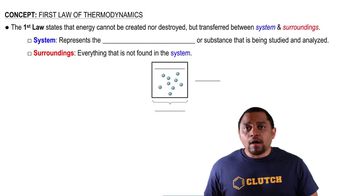
In thermodynamics, work is defined as the energy transferred when a force is applied over a distance. For gases, work can be calculated using the formula W = -PΔV, where W is work, P is pressure, and ΔV is the change in volume. The negative sign indicates that work is done by the system when it expands against an external pressure.
Video consigliato:
Percorso guidato
01:18
First Law of Thermodynamics

Pressure-Volume Work

Pressure-volume work occurs when a gas expands or contracts in response to external pressure. In the context of breathing, when the lungs expand, they do work against the atmospheric pressure. The amount of work done can be quantified by the product of the external pressure and the change in lung volume during inhalation or exhalation.
Video consigliato:
Percorso guidato
02:35
Constant-Volume Calorimetry

Units of Work

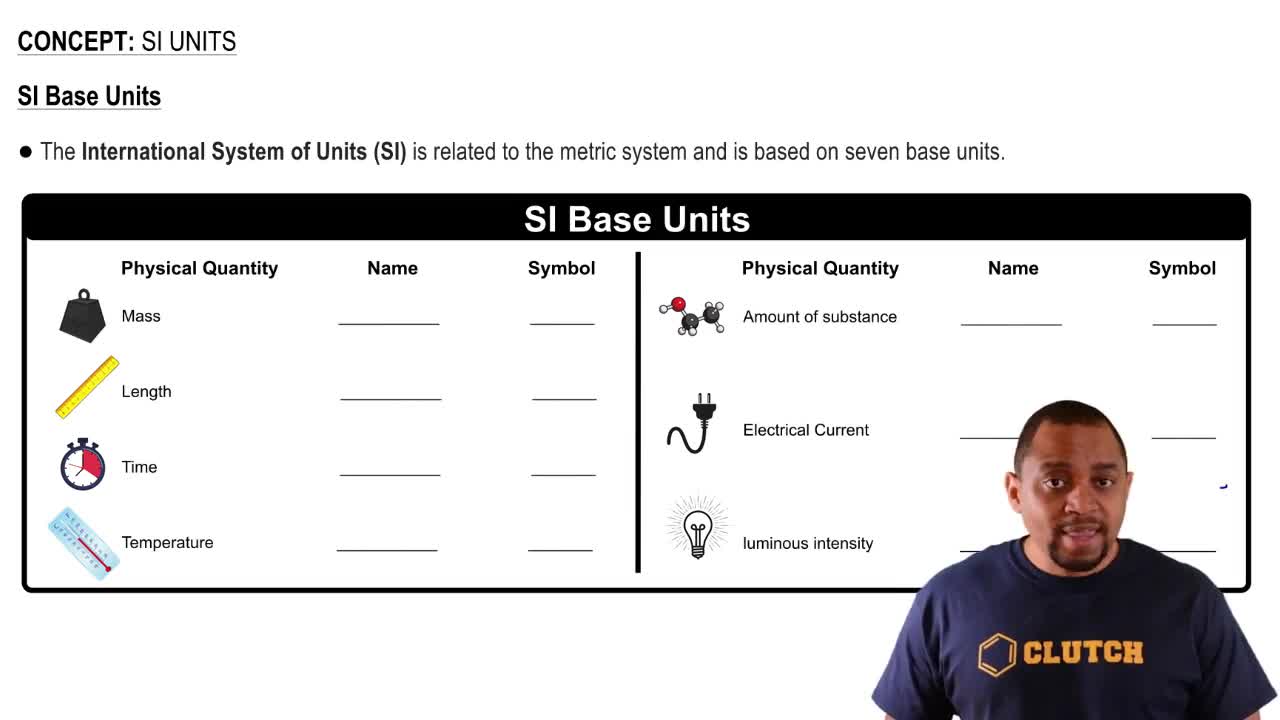
Work is measured in joules (J) in the International System of Units (SI). One joule is defined as the work done when a force of one newton displaces an object by one meter. In the context of the given question, converting the volume change from liters to cubic meters is necessary to ensure that the units are consistent when calculating work.
Video consigliato: