
Ch.5 - Thermochemistry
Brown - Chemistry: The Central Science 15th Edition
Brown15th EditionChemistry: The Central ScienceISBN: 9780137542970Non è quello che usi tu?Cambia libro di testo
Capitolo 5, Problema 66

Given the data N2(g) + O2(g) → 2 NO(g) ΔH = +180.7 kJ 2 NO(g) + O2(g) → 2 NO2(g) ΔH = -113.1 kJ 2 N2O(g) → 2 N2(g) + O2(g) ΔH = -163.2 kJ use Hess's law to calculate ΔH for the reaction N2O(g) + NO2(g) → 3 NO(g)

Guida verificata passo dopo passo
1
Identify the target reaction: \( \text{N}_2\text{O}(g) + \text{NO}_2(g) \rightarrow 3 \text{NO}(g) \).
Write down the given reactions and their enthalpy changes: \( \text{N}_2(g) + \text{O}_2(g) \rightarrow 2 \text{NO}(g) \), \( \Delta H = +180.7 \text{ kJ} \); \( 2 \text{NO}(g) + \text{O}_2(g) \rightarrow 2 \text{NO}_2(g) \), \( \Delta H = -113.1 \text{ kJ} \); \( 2 \text{N}_2\text{O}(g) \rightarrow 2 \text{N}_2(g) + \text{O}_2(g) \), \( \Delta H = -163.2 \text{ kJ} \).
Reverse the third reaction to match the target reaction's reactants: \( 2 \text{N}_2(g) + \text{O}_2(g) \rightarrow 2 \text{N}_2\text{O}(g) \), changing \( \Delta H \) to \(+163.2 \text{ kJ} \).
Adjust the stoichiometry of the reactions to match the target reaction: Divide the first reaction by 2 to get \( \text{N}_2(g) + \frac{1}{2} \text{O}_2(g) \rightarrow \text{NO}(g) \), and divide the second reaction by 2 to get \( \text{NO}(g) + \frac{1}{2} \text{O}_2(g) \rightarrow \text{NO}_2(g) \).
Combine the adjusted reactions to form the target reaction, ensuring that the intermediates cancel out, and sum the enthalpy changes to find \( \Delta H \) for the target reaction.

Risposta video verificata per un problema simile:

Questa soluzione video è stata consigliata dai nostri tutor come utile per risolvere questo problema.
Durata del video:
2m

Concetti chiave

Ecco i concetti essenziali che devi comprendere per rispondere correttamente alla domanda.

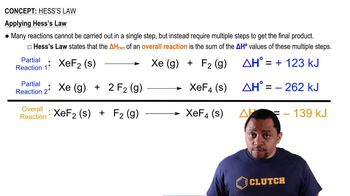
Hess's Law

Hess's Law states that the total enthalpy change for a chemical reaction is the sum of the enthalpy changes for the individual steps of the reaction, regardless of the pathway taken. This principle allows chemists to calculate the enthalpy change for a reaction that may be difficult to measure directly by using known enthalpy changes of related reactions.
Video consigliato:

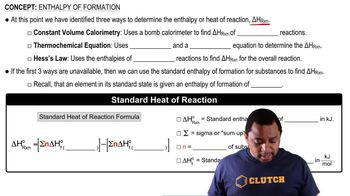
Enthalpy Change (ΔH)

Enthalpy change (ΔH) is a measure of the heat content of a system at constant pressure. It indicates whether a reaction is exothermic (releases heat, ΔH < 0) or endothermic (absorbs heat, ΔH > 0). Understanding ΔH is crucial for predicting the energy changes associated with chemical reactions and for applying Hess's Law effectively.
Video consigliato:
Percorso guidato
02:34
Enthalpy of Formation

Stoichiometry

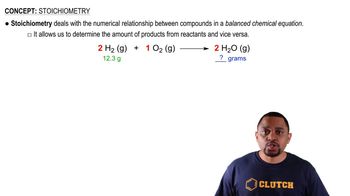
Stoichiometry involves the calculation of reactants and products in chemical reactions based on the balanced chemical equation. It is essential for determining the proportions of substances involved in reactions, which is necessary when applying Hess's Law to combine multiple reactions and find the overall enthalpy change for a target reaction.
Video consigliato:
Percorso guidato
01:16
Stoichiometry Concept
Pratica correlata
Domanda del libro di testo

The concentration of alcohol 1CH3CH2OH2 in blood, called the 'blood alcohol concentration' or BAC, is given in units of grams of alcohol per 100 mL of blood. The legal definition of intoxication, in many states of the United States, is that the BAC is 0.08 or higher. What is the concentration of alcohol, in terms of molarity, in blood if the BAC is 0.08?

2404
views
Domanda del libro di testo

Calculate the enthalpy change for the reaction P4O6(s) + 2 O2(g) → P4O10(s) given the following enthalpies of reaction: P4(s) + 3 O2(g) → P4O6(s) ΔH = -1640.1 kJ P4(s) + 5 O2(g) → P4O10(s) ΔH = -2940.1 kJ

1298
views
Domanda del libro di testo

(c) What is meant by the term standard enthalpy of formation?

456
views
Domanda del libro di testo

From the enthalpies of reaction 2 C(s) + O2(g) → 2 CO(g) ΔH = -221.0 kJ 2 C(s) + O2(g) + 4 H2(g) → 2 CH3OH(g) ΔH = -402.4 kJ Calculate ΔH for the reaction CO(g) + 2 H2(g) → CH3OH(g)

411
views
Domanda del libro di testo

What is the value of the standard enthalpy of formation of an element in its most stable form?

2
views
Domanda del libro di testo

We can use Hess's law to calculate enthalpy changes that cannot be measured. One such reaction is the conversion of methane to ethane: 2 CH4(g) → C2H6(g) + H2(g) Calculate the ΔH° for this reaction using the following thermochemical data: CH4(g) + 2 O2(g) → CO2(g) + 2 H2O(l) ΔH° = -890.3 kJ 2 H2(g) + O2(g) → 2 H2O(l) H° = -571.6 kJ 2 C2H6(g) + 7 O2(g) → 4 CO2(g) + 6 H2O(l) ΔH° = -3120.8 kJ

1171
views