Ch.6 - Electronic Structure of Atoms
Brown - Chemistry: The Central Science 15th Edition
Brown15th EditionChemistry: The Central ScienceISBN: 9780137542970Non è quello che usi tu?Cambia libro di testo
Capitolo 6, Problema 49

Neutron diffraction is an important technique for determining the structures of molecules. Calculate the velocity of a neutron needed to achieve a wavelength of 1.25 Å. The mass of a neutron is 1.675×10⁻²⁷ kg.

Guida verificata passo dopo passo
1
Identify the relationship between velocity, wavelength, and mass using the de Broglie equation: \( \lambda = \frac{h}{mv} \), where \( \lambda \) is the wavelength, \( h \) is Planck's constant (\( 6.626 \times 10^{-34} \) Js), \( m \) is the mass, and \( v \) is the velocity.
Rearrange the de Broglie equation to solve for velocity \( v \): \( v = \frac{h}{m\lambda} \).
Substitute the given values into the equation: \( h = 6.626 \times 10^{-34} \) Js, \( m = 1.675 \times 10^{-27} \) kg, and \( \lambda = 1.25 \times 10^{-10} \) m (since 1 Å = 1 \(\times\) 10^{-10} m).
Calculate the velocity \( v \) by performing the division: \( v = \frac{6.626 \times 10^{-34}}{1.675 \times 10^{-27} \times 1.25 \times 10^{-10}} \).
Ensure the units are consistent and simplify the expression to find the velocity of the neutron.

Risposta video verificata per un problema simile:

Questa soluzione video è stata consigliata dai nostri tutor come utile per risolvere questo problema.
Durata del video:
1m

Concetti chiave

Ecco i concetti essenziali che devi comprendere per rispondere correttamente alla domanda.

De Broglie Wavelength

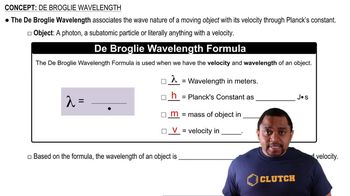
The De Broglie wavelength is a fundamental concept in quantum mechanics that relates the wavelength of a particle to its momentum. It is given by the formula λ = h/p, where λ is the wavelength, h is Planck's constant, and p is the momentum of the particle. For a neutron, the momentum can be expressed as p = mv, where m is the mass and v is the velocity. This relationship is crucial for understanding how particles like neutrons exhibit wave-like properties.
Video consigliato:
Percorso guidato
00:58
De Broglie Wavelength Formula

Planck's Constant

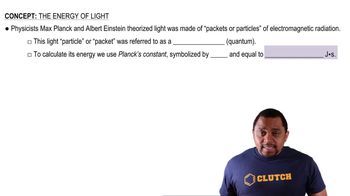
Planck's constant (h) is a fundamental physical constant that plays a central role in quantum mechanics. It has a value of approximately 6.626 × 10^-34 Js and is used to describe the quantization of energy levels in atoms and the wave-particle duality of matter. In the context of neutron diffraction, it is essential for calculating the wavelength of neutrons based on their momentum, thereby linking classical and quantum physics.
Video consigliato:
Percorso guidato
00:50
Photons and Planck's Constant

Kinetic Energy and Velocity

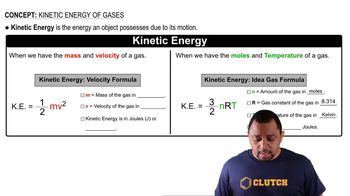
The kinetic energy of a particle is the energy it possesses due to its motion, expressed as KE = 0.5mv², where m is the mass and v is the velocity. In neutron diffraction, the velocity of the neutron is directly related to its kinetic energy and is essential for determining the appropriate conditions for achieving a specific wavelength. Understanding this relationship allows for the calculation of the velocity needed to produce a desired wavelength in neutron scattering experiments.
Video consigliato:
Percorso guidato
02:27
Kinetic Energy Formulas