
Ch.6 - Electronic Structure of Atoms
Brown - Chemistry: The Central Science 15th Edition
Brown15th EditionChemistry: The Central ScienceISBN: 9780137542970Non è quello che usi tu?Cambia libro di testo
Capitolo 6, Problema 38a

Indicate whether energy is emitted or absorbed when the following electronic transitions occur in hydrogen: a. from n = 3 to n = 6

Guida verificata passo dopo passo
1
insert step 1> Determine the initial and final energy levels of the electron in the hydrogen atom. Here, the electron transitions from n = 3 to n = 6.
insert step 2> Recall that energy is absorbed when an electron moves to a higher energy level (higher n value) and emitted when it moves to a lower energy level (lower n value).
insert step 3> Since the electron is moving from n = 3 to n = 6, it is transitioning to a higher energy level.
insert step 4> Conclude that energy is absorbed during this transition because the electron is moving to a higher energy level.
insert step 5> Remember that the energy difference between levels can be calculated using the Rydberg formula if needed, but the key concept here is the direction of the transition.

Risposta video verificata per un problema simile:

Questa soluzione video è stata consigliata dai nostri tutor come utile per risolvere questo problema.
Durata del video:
2m

Concetti chiave

Ecco i concetti essenziali che devi comprendere per rispondere correttamente alla domanda.

Energy Levels in Hydrogen

In hydrogen, electrons occupy discrete energy levels, denoted by quantum numbers (n). The energy associated with each level increases with n, meaning that higher levels (larger n) have more energy. When an electron transitions between these levels, the difference in energy determines whether energy is absorbed or emitted.
Video consigliato:
Percorso guidato
01:22
Hydrogenation Reactions

Absorption and Emission of Energy

When an electron moves from a lower energy level to a higher one (e.g., n = 3 to n = 6), it must absorb energy, typically in the form of a photon. Conversely, when an electron falls from a higher energy level to a lower one, energy is emitted. This principle is fundamental in understanding atomic spectra and the behavior of electrons in atoms.
Video consigliato:
Percorso guidato
01:51
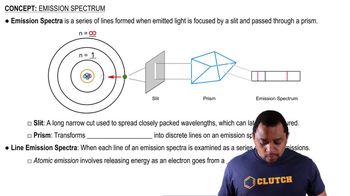
Emission Spectra

Quantum Mechanics and Photons

Quantum mechanics describes the behavior of particles at atomic and subatomic levels. Photons are the quanta of light and carry energy proportional to their frequency. The energy of a photon can be calculated using the equation E = hf, where h is Planck's constant and f is the frequency. This relationship is crucial for understanding how energy is exchanged during electronic transitions.
Video consigliato:
Percorso guidato
01:
Introduction to Quantum Mechanics
Pratica correlata
Domanda del libro di testo

Classify each of the following statements as either true or false: (a) A hydrogen atom in the n = 3 state can emit light at only two specific wavelengths (b) a hydrogen atom in the n = 2 state is at a lower energy than one in the n = 1 state (c) the energy of an emitted photon equals the energy difference of the two states involved in the emission.

663
views
Domanda del libro di testo

Is energy emitted or absorbed when the following electronic transitions occur in hydrogen? a. from n = 4 to n = 2

4
views
Domanda del libro di testo

Is energy emitted or absorbed when the following electronic transitions occur in hydrogen? b. from an orbit of radius 2.12 Å to one of radius 8.46 Å

2
views
Domanda del libro di testo

The visible emission lines observed by Balmer all involved nf = 2. (a) Which of the following is the best explanation of why the lines with nf = 3 are not observed in the visible portion of the spectrum: (i) Transitions to nf = 3 are not allowed to happen, (ii) transitions to nf = 3 emit photons in the infrared portion of the spectrum, (iii) transitions to nf = 3 emit photons in the ultraviolet portion of the spectrum, or (iv) transitions to nf = 3 emit photons that are at exactly the same wavelengths as those to nf = 2.

1104
views
Domanda del libro di testo

a. Using Equation 6.5, calculate the energy of an electron in the hydrogen atom when n = 2 and when n = 6. Calculate the wavelength of the radiation released when an electron moves from n = 6 to n = 2.

3
views
Domanda del libro di testo

Consider a transition of the electron in the hydrogen atom from n = 4 to n = 9. b. Will the light be absorbed or emitted?

2
views