
Ch.6 - Electronic Structure of Atoms
Brown - Chemistry: The Central Science 15th Edition
Brown15th EditionChemistry: The Central ScienceISBN: 9780137542970Non è quello che usi tu?Cambia libro di testo
Capitolo 6, Problema 95

An electron is accelerated through an electric potential to a kinetic energy of 1.6 * 10^-15 J. What is its characteristic wavelength? [Hint: Recall that the kinetic energy of a moving object is E = 1/2 mv^2, where m is the mass of the object and v is the speed of the object.]

Guida verificata passo dopo passo
1
Step 1: Identify the relevant equations. The de Broglie wavelength equation is \( \lambda = \frac{h}{p} \), where \( \lambda \) is the wavelength, \( h \) is Planck's constant, and \( p \) is the momentum of the electron. The momentum \( p \) can be expressed as \( p = mv \), where \( m \) is the mass and \( v \) is the velocity of the electron.
Step 2: Relate kinetic energy to velocity. The kinetic energy \( E \) of the electron is given by \( E = \frac{1}{2}mv^2 \). Rearrange this equation to solve for \( v \): \( v = \sqrt{\frac{2E}{m}} \).
Step 3: Calculate the momentum \( p \) using the velocity. Substitute the expression for \( v \) from Step 2 into the momentum equation \( p = mv \) to get \( p = m \sqrt{\frac{2E}{m}} \). Simplify this to \( p = \sqrt{2mE} \).
Step 4: Substitute the expression for momentum \( p \) into the de Broglie wavelength equation. This gives \( \lambda = \frac{h}{\sqrt{2mE}} \).
Step 5: Substitute known values into the equation. Use Planck's constant \( h = 6.626 \times 10^{-34} \text{ J s} \), the mass of an electron \( m = 9.109 \times 10^{-31} \text{ kg} \), and the given kinetic energy \( E = 1.6 \times 10^{-15} \text{ J} \) to calculate \( \lambda \).

Concetti chiave

Ecco i concetti essenziali che devi comprendere per rispondere correttamente alla domanda.

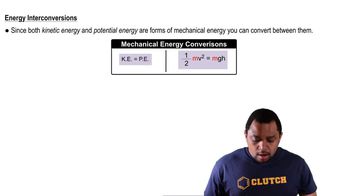
Kinetic Energy

Kinetic energy is the energy possessed by an object due to its motion, calculated using the formula E = 1/2 mv^2, where m is the mass and v is the velocity of the object. In this context, the kinetic energy of the electron is given as 1.6 * 10^-15 J, which will be used to determine its speed and subsequently its wavelength.
Video consigliato:
Percorso guidato
00:34
Kinetic & Potential Energy

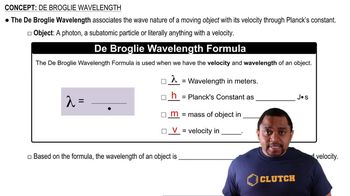
De Broglie Wavelength

The De Broglie wavelength is a concept in quantum mechanics that relates the wavelength of a particle to its momentum, expressed as λ = h/p, where h is Planck's constant and p is the momentum. For an electron, this wavelength can be calculated after determining its velocity from the kinetic energy, illustrating the wave-particle duality of matter.
Video consigliato:
Percorso guidato
00:58
De Broglie Wavelength Formula

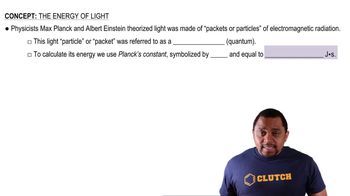
Planck's Constant

Planck's constant (h) is a fundamental constant in quantum mechanics, approximately equal to 6.626 x 10^-34 Js. It plays a crucial role in the relationship between energy and frequency of photons, as well as in calculating the De Broglie wavelength of particles, linking classical and quantum physics.
Video consigliato:
Percorso guidato
00:50
Photons and Planck's Constant