
Ch.6 - Electronic Structure of Atoms
Brown - Chemistry: The Central Science 15th Edition
Brown15th EditionChemistry: The Central ScienceISBN: 9780137542970Non è quello che usi tu?Cambia libro di testo
Capitolo 6, Problema 81b1

Consider the two waves shown here, which we will consider to represent two electromagnetic radiations: (b) What is the frequency of wave A?
Graph showing a wave representing electromagnetic radiation with a wavelength of 3.6 x 10^-9 m.

Guida verificata passo dopo passo
1
Identify the given wavelength (λ) of wave A from the image, which is 3.6 x 10^-9 meters.
Recall the speed of light (c) in a vacuum, which is approximately 3.00 x 10^8 meters per second.
Use the relationship between the speed of light, wavelength, and frequency: c = λν, where ν is the frequency.
Rearrange the formula to solve for frequency (ν): ν = c / λ.
Substitute the given values into the equation: ν = (3.00 x 10^8 m/s) / (3.6 x 10^-9 m).

Risposta video verificata per un problema simile:

Questa soluzione video è stata consigliata dai nostri tutor come utile per risolvere questo problema.
Durata del video:
2m

Concetti chiave

Ecco i concetti essenziali che devi comprendere per rispondere correttamente alla domanda.

Wavelength

Wavelength is the distance between successive crests (or troughs) of a wave, typically measured in meters. In this case, the wavelength of wave A is given as 3.6 x 10^-9 m, which places it in the electromagnetic spectrum, specifically in the ultraviolet or X-ray region. Understanding wavelength is crucial for calculating other wave properties, such as frequency.
Video consigliato:
Percorso guidato
00:31
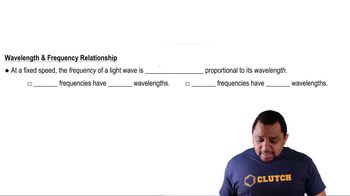
Frequency-Wavelength Relationship

Frequency

Frequency is the number of cycles of a wave that pass a given point per unit time, usually expressed in hertz (Hz). It is inversely related to wavelength; as wavelength increases, frequency decreases, and vice versa. The relationship between frequency (f) and wavelength (λ) is given by the equation f = c/λ, where c is the speed of light in a vacuum (approximately 3.00 x 10^8 m/s).
Video consigliato:
Percorso guidato
00:31
Frequency-Wavelength Relationship

Speed of Light

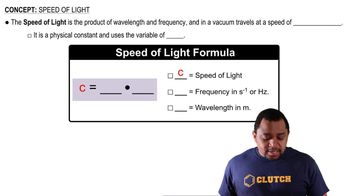
The speed of light in a vacuum is a fundamental constant of nature, approximately 3.00 x 10^8 m/s. This speed is crucial in electromagnetic wave calculations, as it relates wavelength and frequency. The equation c = fλ shows that the speed of light is equal to the product of frequency and wavelength, allowing for the determination of one property if the others are known.
Video consigliato:
Percorso guidato
00:57
Speed of Light Formula
Pratica correlata
Domanda del libro di testo

In August 2011, the Juno spacecraft was launched from Earth with the mission of orbiting Jupiter, arriving nearly five years later in July of 2016. The distance between the two planets varies depending on where each planet is in its orbit, but at the closest, the distance between Jupiter and Earth is 391 million miles. What is the minimum amount of time it takes for a transmitted signal from Juno to reach the Earth?

3
views
Domanda del libro di testo

Certain elements emit light of a specific wavelength when they are burned or heated in a non-luminous flame. Historically, chemists used such emission wavelengths to determine whether specific elements were present in a sample. Some characteristic wavelengths for a few of the elements are given in the following table:

Ag 328.1 nm Fe 372.0 nm

Au 267.6 nm K 404.7 nm

Ba 455.4 nm Mg 285.2 nm

Ca 422.7 nm Na 589.6 nm

Cu 324.8 nm Ni 341.5 nm

(c) When burned, a sample of an unknown substance is found to emit light of frequency 6.58 * 1014 s-1. Which of these elements is probably in the sample?

3
views
Domanda del libro di testo

Consider the two waves shown here, which we will consider to represent two electromagnetic radiations: (a) What is the wavelength of wave A?

491
views
Domanda del libro di testo

The following electron configurations represent excited states. Identify the element and write its ground-state condensed electron configuration. (b) 3Ar44s13d104p25p1

3
views
Domanda del libro di testo

If you put 120 volts of electricity through a pickle, the pickle will smoke and start glowing orange-yellow. The light is emitted because sodium ions in the pickle become excited; their return to the ground state results in light emission. b. What is the energy of 1.00 mol of these photons? (A mole of photons is called an Einstein.)

3
views
Domanda del libro di testo

The following do not represent valid ground-state electron configurations for an atom either because they violate the Pauli exclusion principle or because orbitals are not filled in order of increasing energy. Indicate which of these two principles is violated in each example. b. 3Xe46s25d4

3
views