Using Heisenberg’s uncertainty principle, calculate the uncertainty in the position of b. a proton moving at a speed of (5.00±0.01) × 104 m/s. The mass of a proton is 1.673×10⁻²⁷ kg.
Ch.6 - Electronic Structure of Atoms

Brown15th EditionChemistry: The Central ScienceISBN: 9780137542970Non è quello che usi tu?Cambia libro di testo
Capitolo 6, Problema 56b
How many unique combinations of the quantum numbers l and 𝑚𝑙 are there when b. n = 4?
Guida verificata passo dopo passo1
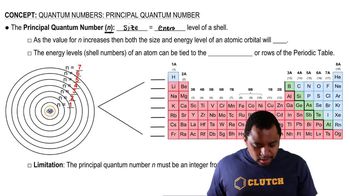
n is the principal quantum number, and it determines the energy level of an electron in an atom. For n = 4, the possible values of the azimuthal quantum number l range from 0 to n - 1.
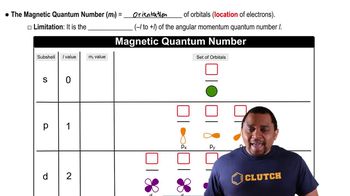
For each value of l, the magnetic quantum number ml can take integer values from -l to +l, including zero.
Calculate the number of possible ml values for each l value. For example, if l = 0, ml can only be 0, giving 1 combination.
Continue this process for l = 1, 2, and 3, calculating the number of ml values for each.
Sum the number of combinations for each l value to find the total number of unique combinations of l and ml when n = 4.

Risposta video verificata per un problema simile:
Questa soluzione video è stata consigliata dai nostri tutor come utile per risolvere questo problema.
Durata del video:
3mConcetti chiave
Ecco i concetti essenziali che devi comprendere per rispondere correttamente alla domanda.
Quantum Numbers
Quantum numbers are sets of numerical values that describe the unique quantum state of an electron in an atom. They include the principal quantum number (n), azimuthal quantum number (l), magnetic quantum number (ml), and spin quantum number (ms). Each quantum number provides specific information about the electron's energy level, shape of the orbital, orientation, and spin.
Video consigliato:
Percorso guidato
Principal Quantum Number
Azimuthal Quantum Number (l)
The azimuthal quantum number (l) determines the shape of an electron's orbital and can take on integer values from 0 to n-1, where n is the principal quantum number. For n = 4, l can be 0, 1, 2, or 3, corresponding to the s, p, d, and f orbitals, respectively. Each value of l defines a different type of orbital with distinct shapes.
Video consigliato:
Percorso guidato
Magnetic Quantum Number
Magnetic Quantum Number (ml)
The magnetic quantum number (ml) specifies the orientation of an orbital in space and can take on integer values ranging from -l to +l, including zero. For each value of l, there are 2l + 1 possible values of ml. For example, if l = 2 (d orbital), ml can be -2, -1, 0, +1, or +2, resulting in five unique orientations.
Video consigliato:
Percorso guidato
Magnetic Quantum Number
Pratica correlata
Domanda del libro di testo
1
views
Domanda del libro di testo
(a) For n = 4, what are the possible values of l?
1164
views
Domanda del libro di testo
Give the values for n, l, and 𝑚𝑙 for a. each orbital in the 2p subshell
2
views
Domanda del libro di testo
Calculate the uncertainty in the position of (a) an electron moving at a speed of 13.00 ± 0.012 × 10⁵ m/s (b) a neutron moving at this same speed. (The masses of an electron and a neutron are given in the table of fundamental constants in the inside cover of the text.)
900
views
1
rank
Domanda del libro di testo
Give the numerical values of n and l corresponding to each of the following orbital designations: (a) 3p (b) 2s (c) 4f
505
views
Domanda del libro di testo
Give the numerical values of n and l corresponding to each of the following orbital designations: (d) 5d.
791
views