Ch.6 - Electronic Structure of Atoms
Brown - Chemistry: The Central Science 15th Edition
Brown15th EditionChemistry: The Central ScienceISBN: 9780137542970Non è quello che usi tu?Cambia libro di testo
Capitolo 6, Problema 102c

In the experiment shown schematically below, a beam of neutral atoms is passed through a magnetic field. Atoms that have unpaired electrons are deflected in different directions in the magnetic field depending on the value of the electron spin quantum number. In the experiment illustrated, we envision that a beam of hydrogen atoms splits into two beams. (c) What do you think would happen if the beam of hydrogen atoms were replaced with a beam of helium atoms? Why?
Schematic of an experiment showing a beam of atoms passing through a horseshoe magnet and splitting.

Guida verificata passo dopo passo
1
Step 1: Understand the experiment setup. A beam of neutral hydrogen atoms is passed through a magnetic field created by a horseshoe magnet, causing the beam to split into two due to the electron spin quantum number.
Step 2: Recall that hydrogen atoms have one electron, which can have a spin quantum number of +1/2 or -1/2, leading to the observed splitting.
Step 3: Consider the electronic configuration of helium atoms. Helium has two electrons, both of which are paired in the 1s orbital.
Step 4: Recognize that paired electrons in helium have opposite spins, resulting in a net spin of zero. This means helium atoms do not have unpaired electrons.
Step 5: Conclude that if the beam of hydrogen atoms is replaced with a beam of helium atoms, the beam would not split in the magnetic field because helium atoms do not have unpaired electrons to interact with the magnetic field.

Risposta video verificata per un problema simile:

Questa soluzione video è stata consigliata dai nostri tutor come utile per risolvere questo problema.
Durata del video:
1m

Concetti chiave

Ecco i concetti essenziali che devi comprendere per rispondere correttamente alla domanda.

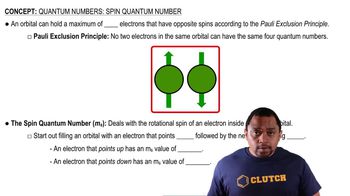
Electron Spin Quantum Number

The electron spin quantum number describes the intrinsic angular momentum of electrons, which can take on values of +1/2 or -1/2. This property is crucial in determining how electrons behave in magnetic fields, as unpaired electrons will align with or against the field, leading to observable deflections in experiments like the one described.
Video consigliato:
Percorso guidato
01:18
Spin Quantum Number

Magnetic Deflection of Atoms

When a beam of neutral atoms passes through a magnetic field, atoms with unpaired electrons experience a force due to their magnetic moments. This results in a deflection of the atoms' paths, which can be measured to infer properties about the atoms, such as their electron configurations and the presence of unpaired electrons.
Video consigliato:
Percorso guidato
00:59
Magnetic Quantum Example

Comparison of Hydrogen and Helium

Hydrogen has one electron, which can be unpaired, while helium has two electrons that are paired, resulting in no net magnetic moment. If a beam of helium atoms were used instead of hydrogen, we would expect minimal or no deflection in the magnetic field, as the paired electrons in helium do not contribute to a magnetic moment that would interact with the field.
Video consigliato:
Percorso guidato
01:22
Hydrogenation Reactions