Label each of the following statements as true or false. a. Visible light is a form of electromagnetic radiation.
Ch.6 - Electronic Structure of Atoms

Brown15th EditionChemistry: The Central ScienceISBN: 9780137542970Non è quello che usi tu?Cambia libro di testo
Capitolo 6, Problema 12
State where in the periodic table these elements appear: (a) elements with the valence-shell electron configuration ns2np5 (b) elements that have three unpaired p electrons (c) an element whose valence electrons are 4s24p1 (d) the d-block elements [Section 6.9]
Guida verificata passo dopo passo1
Identify the general electron configuration for each case and relate it to the periodic table sections: s-block, p-block, d-block, and f-block.
For part (a), recognize that the electron configuration ns2np5 corresponds to halogens, which are located in Group 17 of the p-block.
For part (b), elements with three unpaired p electrons typically have a p3 configuration, placing them in Group 15 of the p-block.
For part (c), the electron configuration 4s24p1 indicates an element in the 4th period of the p-block, specifically in Group 13.
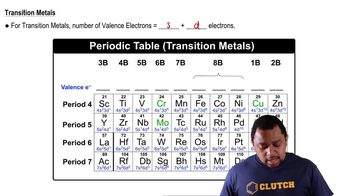
For part (d), understand that the d-block elements are transition metals, which are found in the central block of the periodic table, specifically Groups 3 through 12.

Risposta video verificata per un problema simile:
Questa soluzione video è stata consigliata dai nostri tutor come utile per risolvere questo problema.
Durata del video:
3mConcetti chiave
Ecco i concetti essenziali che devi comprendere per rispondere correttamente alla domanda.
Valence Electron Configuration
Valence electron configuration describes the distribution of electrons in the outermost shell of an atom. The notation 'ns2np5' indicates that the element has two electrons in the s subshell and five in the p subshell of its highest energy level, which corresponds to the halogens in Group 17 of the periodic table.
Video consigliato:
Percorso guidato
Transition Metals Valence Electrons
Unpaired Electrons
Unpaired electrons are those that occupy an orbital alone rather than in pairs. Elements with three unpaired p electrons typically belong to Group 15 of the periodic table, where the p subshell has three electrons, leading to unique chemical properties and reactivity.
Video consigliato:
Percorso guidato
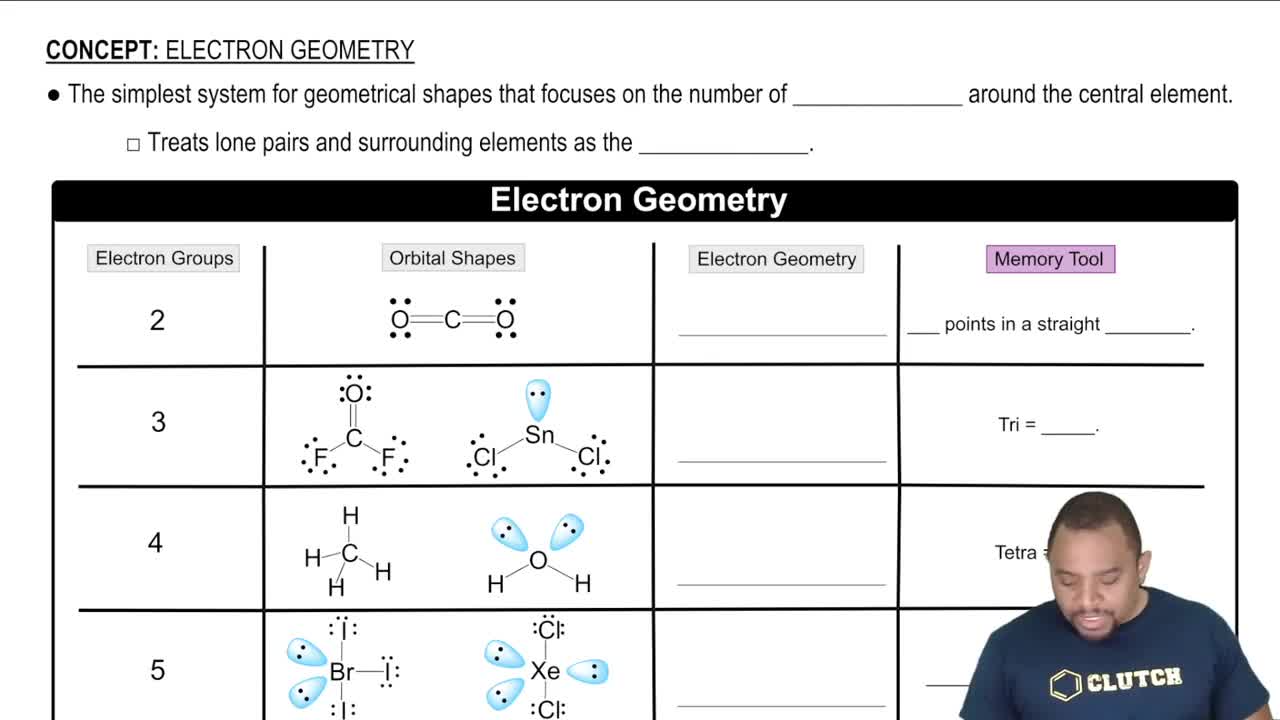
Electron Geometry
d-block Elements
The d-block elements, also known as transition metals, are found in Groups 3 to 12 of the periodic table. These elements are characterized by the filling of d orbitals and exhibit properties such as variable oxidation states and the ability to form colored compounds, making them essential in various chemical reactions and applications.
Video consigliato:
Percorso guidato
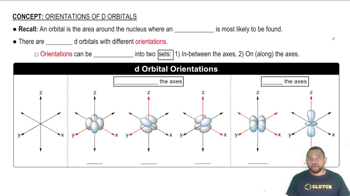
d Orbital Orientations
Pratica correlata
Domanda del libro di testo
2
views
Domanda del libro di testo
Four possible electron configurations for a nitrogen atom are shown below, but only one schematic represents the correct configuration for a nitrogen atom in its ground state. Which configurations violate the Pauli exclusion principle?
752
views
Domanda del libro di testo
Four possible electron configurations for a carbon atom are shown below, but only one schematic represents the correct configuration for a carbon atom in its ground state. Which one is the correct electron configuration?
2654
views
1
rank
1
comments
Domanda del libro di testo
The accompanying drawing shows a contour plot for a dyz orbital. Consider the quantum numbers that could potentially correspond to this orbital. (d) The probability density goes to zero along which of the following planes: xy, xz, or yz?
737
views