Ch.6 - Electronic Structure of Atoms
Brown - Chemistry: The Central Science 15th Edition
Brown15th EditionChemistry: The Central ScienceISBN: 9780137542970Non è quello che usi tu?Cambia libro di testo
Capitolo 6, Problema 90c

The human retina has three types of receptor cones, each sensitive to a different range of wavelengths of visible light, as shown in this figure (the colors are merely to differentiate the three curves from one another; they do not indicate the actual colors represented by each curve):
Graph showing three curves representing human cone sensitivity to light wavelengths.
(c) Explain why the sky appears blue even though all wavelengths of solar light are scattered by the atmosphere.

Guida verificata passo dopo passo
1
Identify the three types of cones in the human retina: S-cones (blue), M-cones (green), and L-cones (red).
Observe that S-cones are most sensitive to wavelengths around 450 nm, M-cones to around 530 nm, and L-cones to around 560 nm.
Understand that Rayleigh scattering is more effective at shorter wavelengths, which means blue light (shorter wavelength) is scattered more than red light (longer wavelength).
Note that even though all wavelengths of solar light are scattered, the higher sensitivity of S-cones to blue light makes the sky appear predominantly blue to the human eye.
Conclude that the combination of the scattering effect and the sensitivity of the S-cones results in the perception of a blue sky.

Risposta video verificata per un problema simile:

Questa soluzione video è stata consigliata dai nostri tutor come utile per risolvere questo problema.
Durata del video:
1m

Concetti chiave

Ecco i concetti essenziali che devi comprendere per rispondere correttamente alla domanda.

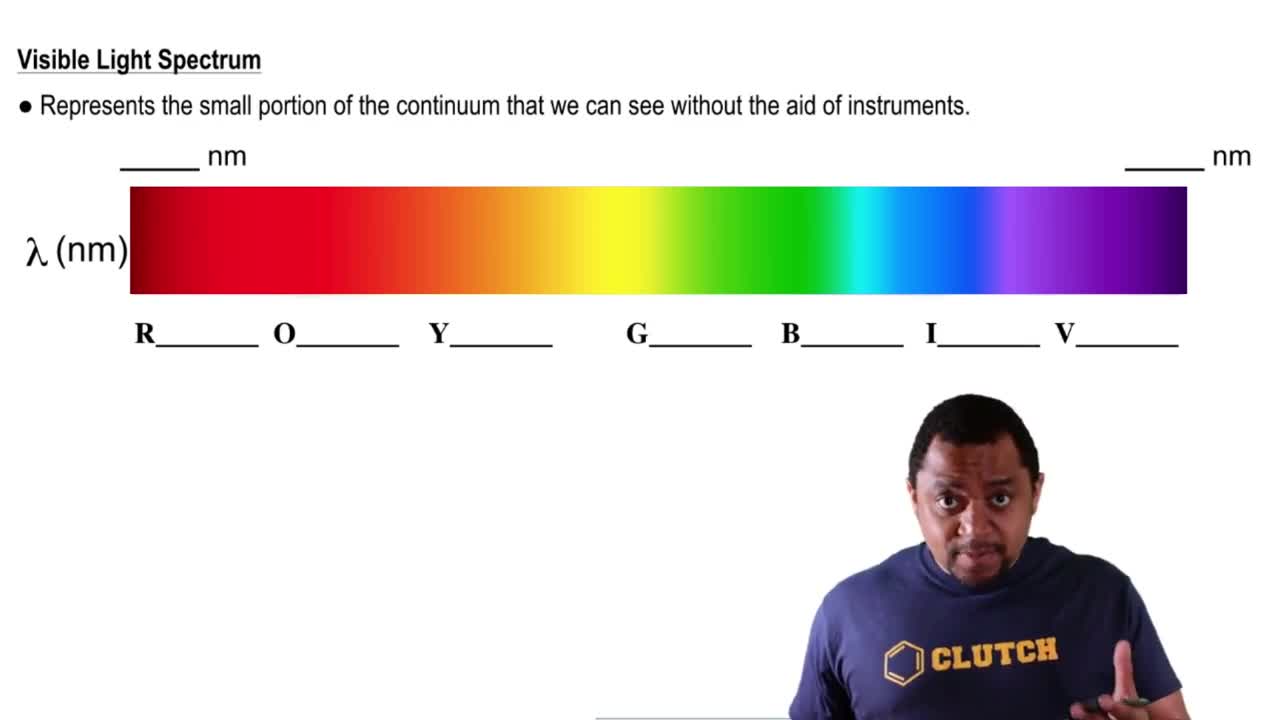
Visible Light Spectrum

The visible light spectrum is the portion of the electromagnetic spectrum that is visible to the human eye, typically ranging from about 380 nm (violet) to 750 nm (red). Different wavelengths correspond to different colors, with shorter wavelengths appearing blue and longer wavelengths appearing red. Understanding this spectrum is crucial for explaining how light interacts with objects and how it is perceived by the human eye.
Video consigliato:
Percorso guidato
01:24
Visible Light Spectrum

Rayleigh Scattering

Rayleigh scattering is the scattering of light or other electromagnetic radiation by particles much smaller than the wavelength of the light. This phenomenon is responsible for the blue color of the sky, as shorter wavelengths (blue light) are scattered more than longer wavelengths (red light) when sunlight passes through the Earth's atmosphere. This selective scattering leads to a predominance of blue light reaching our eyes from all directions in the sky.
Video consigliato:

Cone Photoreceptors

Cone photoreceptors are specialized cells in the retina that are responsible for color vision. There are three types of cones, each sensitive to different ranges of wavelengths corresponding to blue, green, and red light. The relative activation of these cones allows the brain to perceive a wide range of colors, including the blue of the sky, which is primarily detected by the cones sensitive to shorter wavelengths.
Video consigliato:
Percorso guidato
01:04
Radial and Angular Nodes