Ch.6 - Electronic Structure of Atoms
Brown - Chemistry: The Central Science 15th Edition
Brown15th EditionChemistry: The Central ScienceISBN: 9780137542970Non è quello che usi tu?Cambia libro di testo
Capitolo 6, Problema 61

Which of the following represent impossible combinations of n and l? (a) 1p (b) 4s (c) 5f (d) 2d

Guida verificata passo dopo passo
1
Understand the quantum numbers: The principal quantum number, n, can be any positive integer (1, 2, 3, ...). The azimuthal quantum number, l, can be any integer from 0 to n-1.
Identify the possible values of l for each n: For n=1, l can only be 0 (s orbital). For n=2, l can be 0 (s) or 1 (p). For n=3, l can be 0 (s), 1 (p), or 2 (d). For n=4, l can be 0 (s), 1 (p), 2 (d), or 3 (f).
Analyze each option: (a) 1p: Here, n=1 and l=1. Since l must be less than n, this is impossible.
Analyze each option: (b) 4s: Here, n=4 and l=0. This is possible because l=0 is within the range for n=4.
Analyze each option: (c) 5f: Here, n=5 and l=3. This is possible because l=3 is within the range for n=5.

Risposta video verificata per un problema simile:

Questa soluzione video è stata consigliata dai nostri tutor come utile per risolvere questo problema.
Durata del video:
4m

Concetti chiave

Ecco i concetti essenziali che devi comprendere per rispondere correttamente alla domanda.

Quantum Numbers

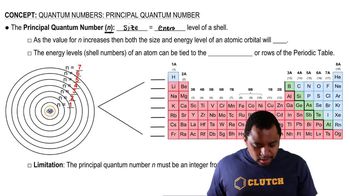
Quantum numbers are a set of four numbers that describe the unique quantum state of an electron in an atom. The principal quantum number (n) indicates the energy level, while the azimuthal quantum number (l) defines the shape of the orbital. Each value of n allows for specific values of l, which must be less than n.
Video consigliato:
Percorso guidato
02:55
Principal Quantum Number

Allowed Values of l

The azimuthal quantum number (l) can take on integer values from 0 to n-1 for a given principal quantum number (n). For example, if n=2, l can be 0 (s orbital) or 1 (p orbital), but not 2. This restriction is crucial for determining valid combinations of n and l.
Video consigliato:
Percorso guidato
01:56
Gas Constant Values

Orbital Designations

Orbitals are designated by a combination of the principal quantum number (n) and the azimuthal quantum number (l), represented by letters (s, p, d, f). For instance, 'p' corresponds to l=1, 'd' to l=2, and 'f' to l=3. Understanding these designations helps identify which combinations of n and l are valid or impossible.
Video consigliato:
Percorso guidato
03:06
Molecular Orbital Theory