Ch.7 - Periodic Properties of the Elements
Brown - Chemistry: The Central Science 15th Edition
Brown15th EditionChemistry: The Central ScienceISBN: 9780137542970Non è quello che usi tu?Cambia libro di testo
Capitolo 7, Problema 85

The following observations are made about two hypothetical elements A and B: The A—A and B—B bond lengths in the elemental forms of A and B are 2.36 and 1.94 Å, respectively. A and B react to form the binary compound AB2, which has a linear structure (that is, ∠B-A-B=180°). Based on these statements, predict the separation between the two B nuclei in a molecule of AB2.

Guida verificata passo dopo passo
1
Identify the bond lengths given: A—A is 2.36 Å and B—B is 1.94 Å.
Recognize that AB2 has a linear structure, meaning the angle ∠B-A-B is 180°.
In a linear molecule like AB2, the separation between the two B nuclei is the sum of the bond lengths A—B and B—A.
Assume that the bond length A—B is the average of A—A and B—B bond lengths, as a first approximation.
Calculate the separation between the two B nuclei by adding twice the A—B bond length (since there are two A—B bonds in AB2).

Risposta video verificata per un problema simile:

Questa soluzione video è stata consigliata dai nostri tutor come utile per risolvere questo problema.
Durata del video:
4m

Concetti chiave

Ecco i concetti essenziali che devi comprendere per rispondere correttamente alla domanda.

Bond Length

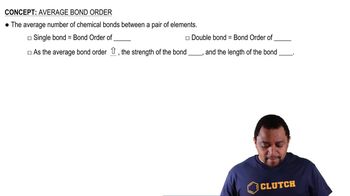
Bond length is the average distance between the nuclei of two bonded atoms. It is influenced by the types of atoms involved and the nature of the bond (single, double, etc.). In this case, the bond lengths of A—A and B—B provide insight into the strength and characteristics of the bonds formed in the compound AB2.
Video consigliato:
Percorso guidato
00:36
Average Bond Order

Molecular Geometry

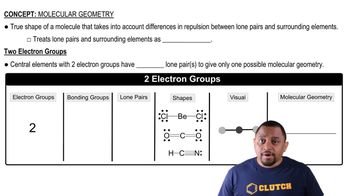
Molecular geometry refers to the three-dimensional arrangement of atoms in a molecule. The linear structure of AB2, indicated by the bond angle of 180°, suggests that the two B atoms are positioned directly opposite each other with respect to the A atom, which affects the overall spatial configuration and bond lengths in the compound.
Video consigliato:
Percorso guidato
01:33
Molecular Geometry with Two Electron Groups

VSEPR Theory

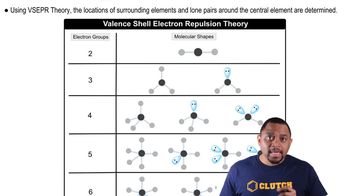
Valence Shell Electron Pair Repulsion (VSEPR) theory is used to predict the geometry of molecules based on the repulsion between electron pairs around a central atom. In the case of AB2, the linear arrangement arises because the two B atoms repel each other and the lone pairs or other bonding pairs around A, leading to a straight-line configuration.
Video consigliato:
Percorso guidato
02:13
Molecular Shapes and VSEPR