

Ch.7 - Periodic Properties of the Elements
Brown - Chemistry: The Central Science 15th Edition
Brown15th EditionChemistry: The Central ScienceISBN: 9780137542970Non è quello che usi tu?Cambia libro di testo
Capitolo 7, Problema 89

Explain the variation in the ionization energies of carbon, as displayed in this graph:

Guida verificata passo dopo passo
1
Ionization energy is the energy required to remove an electron from an atom in the gaseous state.
For carbon, the first ionization energy involves removing one electron from a neutral carbon atom.
The second ionization energy involves removing a second electron from the positively charged ion, which requires more energy due to increased effective nuclear charge.
As more electrons are removed, the ionization energy increases because the remaining electrons are held more tightly by the nucleus.
The graph likely shows a significant increase in ionization energy after the removal of the fourth electron, as this involves breaking into a new electron shell, which is more stable and requires more energy to remove an electron from.

Risposta video verificata per un problema simile:

Questa soluzione video è stata consigliata dai nostri tutor come utile per risolvere questo problema.
Durata del video:
1m

Concetti chiave

Ecco i concetti essenziali che devi comprendere per rispondere correttamente alla domanda.

Ionization Energy

Ionization energy is the energy required to remove an electron from an atom or ion in its gaseous state. It reflects the strength of the attraction between the nucleus and the electrons. Higher ionization energy indicates a stronger hold on the electrons, while lower ionization energy suggests that electrons can be removed more easily.
Video consigliato:
Percorso guidato
01:19
Ionization Energy

Trends in Ionization Energy

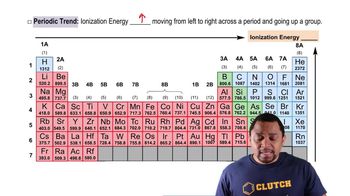
Ionization energy generally increases across a period in the periodic table due to increasing nuclear charge, which enhances the attraction between the nucleus and the electrons. Conversely, it decreases down a group because the added electron shells increase the distance between the nucleus and the outermost electrons, reducing the effective nuclear charge experienced by these electrons.
Video consigliato:
Percorso guidato
01:08
Ionization Energy Trends

Electron Configuration

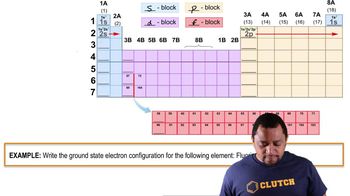
The electron configuration of an element describes the distribution of electrons among the various atomic orbitals. For carbon, with an atomic number of 6, the electron configuration is 1s² 2s² 2p². Understanding this configuration helps explain the ionization energies, as the arrangement of electrons influences how easily they can be removed from the atom.
Video consigliato:
Percorso guidato
01:33
Electron Configuration Example
Pratica correlata
Domanda del libro di testo

(d) Lithium is not nearly as abundant as sodium. If sodium ion batteries were developed that function in the same manner as lithium ion batteries, do you think 'sodium cobalt oxide' would still work as the electrode material? Explain.

504
views
Domanda del libro di testo

The ionic substance strontium oxide, SrO, forms from the reaction of strontium metal with molecular oxygen. The arrangement of the ions in solid SrO is analogous to that in solid NaCl:

(c) The density of SrO is 5.10 g>cm3. Given your answer to part (b), how many formula units of SrO are contained in the cube shown here?

1144
views
Domanda del libro di testo

The ionic substance strontium oxide, SrO, forms from the reaction of strontium metal with molecular oxygen. The arrangement of the ions in solid SrO is analogous to that in solid NaCl: (a) Write a balanced equation for the formation of SrO(s) from its elements.

1034
views
Domanda del libro di testo

The ionic substance strontium oxide, SrO, forms from the reaction of strontium metal with molecular oxygen. The arrangement of the ions in solid SrO is analogous to that in solid NaCl:

(b) Based on the ionic radii in Figure 7.8, predict the length of the side of the cube in the figure (the distance from the center of an atom at one corner to the center of an atom at a neighboring corner).

966
views
Domanda del libro di testo

Elements in group 7A in the periodic table are called the halogens; elements in group 6A are called the chalcogens. (a) What is the most common oxidation state of the chalcogens compared to the halogens?

1811
views
Domanda del libro di testo

(c) Will the lithium cobalt oxide cathode expand or contract as lithium ions are inserted?

529
views