
Domanda del libro di testo
Identify two ions that have the following ground-state electron configurations: (b) [Ar]3d5
373
views

 Guida verificata passo dopo passo
 01:33
01:33
 01:53
01:53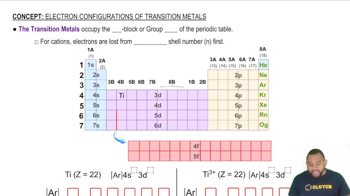 03:12
03:12Identify two ions that have the following ground-state electron configurations: (b) [Ar]3d5
Which of the following chemical equations is connected to the definitions of (a) the first ionization energy of oxygen (i) O1g2 + e-¡O-1g2 (ii) O1g2¡O+1g2 + e- (iii) O1g2 + 2 e-¡O2-1g2 (iv) O1g2¡O2+1g2 + 2 e- (v) O+1g2¡O2+1g2 + e-
The first ionization energy of the oxygen molecule is the energy required for the following process: O21g2¡O2 +1g2 + e- The energy needed for this process is 1175 kJ>mol, very similar to the first ionization energy of Xe. Would you expect O2 to react with F2? If so, suggest a product or products of this reaction.
Hydrogen is an unusual element because it behaves in some ways like the alkali metal elements and in other ways like nonmetals. Its properties can be explained in part by its electron configuration and by the values for its ionization energy and electron affinity. (a) Explain why the electron affinity of hydrogen is much closer to the values for the alkali elements than for the halogens.
Identify two ions that have the following ground-state electron configurations: (a) [Ar]