
Ch.8 - Basic Concepts of Chemical Bonding
Brown - Chemistry: The Central Science 15th Edition
Brown15th EditionChemistry: The Central ScienceISBN: 9780137542970Non è quello che usi tu?Cambia libro di testo
Capitolo 8, Problema 45b

(b) If you were to put HBr under very high pressure, so its bond length decreased significantly, would its dipole moment increase, decrease, or stay the same, if you assume that the effective charges on the atoms do not change?

Guida verificata passo dopo passo
1
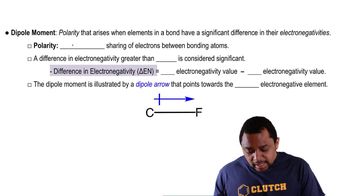
Understand that the dipole moment (\(\mu\)) is calculated using the formula \(\mu = q \times d\), where \(q\) is the charge and \(d\) is the bond length.
Recognize that the problem states the effective charges on the atoms do not change, meaning \(q\) remains constant.
Note that the bond length \(d\) is decreasing due to high pressure.
Since \(\mu = q \times d\) and \(q\) is constant, a decrease in \(d\) will lead to a decrease in the dipole moment \(\mu\).
Conclude that the dipole moment of HBr will decrease if the bond length decreases significantly under high pressure.

Risposta video verificata per un problema simile:

Questa soluzione video è stata consigliata dai nostri tutor come utile per risolvere questo problema.
Durata del video:
1m

Concetti chiave

Ecco i concetti essenziali che devi comprendere per rispondere correttamente alla domanda.

Dipole Moment

The dipole moment is a measure of the separation of positive and negative charges in a molecule, indicating the polarity of the bond. It is calculated as the product of the charge and the distance between the charges. A higher dipole moment signifies a more polar bond, while a dipole moment of zero indicates a nonpolar bond.
Video consigliato:

Bond Length and Polarity

Bond length refers to the distance between the nuclei of two bonded atoms. In general, as bond length decreases, the electron density between the atoms increases, which can enhance the bond's polarity. However, if the effective charges remain unchanged, the overall dipole moment may not necessarily increase, despite the shorter bond length.
Video consigliato:
Percorso guidato
02:38
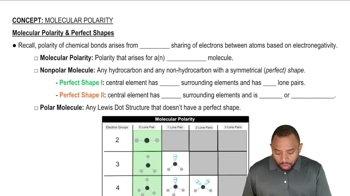
Molecular Polarity

Effect of Pressure on Molecular Structure

Applying high pressure to a gas can lead to a decrease in bond lengths due to the closer proximity of atoms. This compression can alter molecular interactions and properties, but if the effective charges on the atoms do not change, the intrinsic polarity of the bond, and thus the dipole moment, may remain constant despite the change in bond length.
Video consigliato:
Percorso guidato
02:31
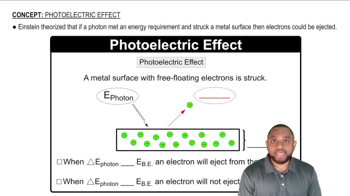
Photoelectric Effect