Ch.8 - Basic Concepts of Chemical Bonding
Brown - Chemistry: The Central Science 15th Edition
Brown15th EditionChemistry: The Central ScienceISBN: 9780137542970Non è quello che usi tu?Cambia libro di testo
Capitolo 8, Problema 61b

b. Which of these compounds or ions is an exception to the octet rule: nitrogen dioxide, borohydride (BH4−), borazine (B3N3H6 which is analogous to benzene with alternating B and N in the ring), or boron trichloride?

Guida verificata passo dopo passo
1
Identify the octet rule, which states that atoms tend to form compounds in ways that give them eight valence electrons, resembling the electron configuration of a noble gas.
Examine each compound or ion to determine if it follows the octet rule.
Consider nitrogen dioxide (NO2): Nitrogen can have an odd number of electrons, making it a radical and an exception to the octet rule.
Analyze borohydride (BH4−): Boron typically forms compounds with fewer than eight electrons, but in BH4−, boron achieves an octet by forming four bonds with hydrogen.
Evaluate borazine (B3N3H6) and boron trichloride (BCl3): Boron in BCl3 does not achieve an octet, as it only has six valence electrons, making it an exception to the octet rule.

Risposta video verificata per un problema simile:

Questa soluzione video è stata consigliata dai nostri tutor come utile per risolvere questo problema.
Durata del video:
3m

Concetti chiave

Ecco i concetti essenziali che devi comprendere per rispondere correttamente alla domanda.

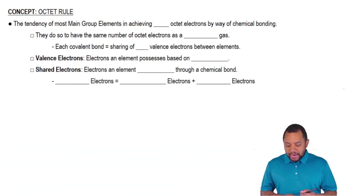
Octet Rule

The octet rule is a chemical guideline that states atoms tend to bond in such a way that they each have eight electrons in their valence shell, achieving a stable electron configuration similar to that of noble gases. This rule primarily applies to main group elements and helps predict the bonding behavior of atoms in molecules.
Video consigliato:

Exceptions to the Octet Rule

Certain compounds and ions do not follow the octet rule, which can occur in cases of elements with fewer than eight valence electrons, such as boron and aluminum, or in molecules with an odd number of electrons. These exceptions are important for understanding the behavior of certain compounds, particularly those involving transition metals or elements from the third period and beyond.
Video consigliato:

Molecular Geometry and Hybridization

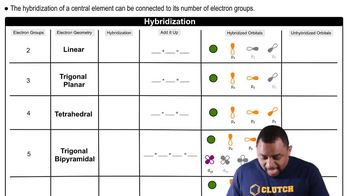
Molecular geometry refers to the three-dimensional arrangement of atoms within a molecule, which is influenced by the number of bonding and lone pairs of electrons. Hybridization is the concept of mixing atomic orbitals to form new hybrid orbitals that can accommodate the bonding requirements of the molecule, affecting its shape and reactivity, particularly in compounds that do not adhere to the octet rule.
Video consigliato:
Percorso guidato
03:06
Hybridization and Electron Geometry