
Ch.8 - Basic Concepts of Chemical Bonding
Brown - Chemistry: The Central Science 15th Edition
Brown15th EditionChemistry: The Central ScienceISBN: 9780137542970Non è quello che usi tu?Cambia libro di testo
Capitolo 8, Problema 24b

NaCl and KF have the same crystal structure. The only difference between the two is the distance that separates cations and anions. (b) Use the ionic radii given in Figure 7.8 to estimate the Na─Cl and K─F distances.

Guida verificata passo dopo passo
1
Identify the ionic radii for Na^+ and Cl^- from Figure 7.8.
Identify the ionic radii for K^+ and F^- from Figure 7.8.
Add the ionic radius of Na^+ to the ionic radius of Cl^- to estimate the Na─Cl distance.
Add the ionic radius of K^+ to the ionic radius of F^- to estimate the K─F distance.
Compare the estimated distances to understand the difference in separation between the cations and anions in NaCl and KF.

Risposta video verificata per un problema simile:

Questa soluzione video è stata consigliata dai nostri tutor come utile per risolvere questo problema.
Durata del video:
2m

Concetti chiave

Ecco i concetti essenziali che devi comprendere per rispondere correttamente alla domanda.

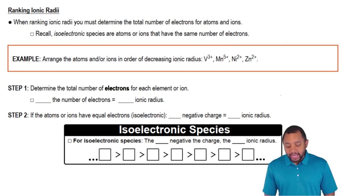
Ionic Radii

Ionic radii refer to the effective size of an ion in a crystal lattice, which is influenced by its charge and the surrounding ions. Cations are typically smaller than their neutral atoms due to the loss of electrons, while anions are larger due to the gain of electrons. Understanding ionic radii is crucial for estimating distances between ions in ionic compounds.
Video consigliato:
Percorso guidato
03:56
Ranking Ionic Radii

Crystal Structure

Crystal structure describes the orderly arrangement of ions in a solid, which determines the properties of the material. In the case of NaCl and KF, both adopt a face-centered cubic lattice structure, where each ion is surrounded by six oppositely charged ions. This arrangement is essential for understanding how ionic distances are calculated based on the positions of cations and anions.
Video consigliato:
Percorso guidato
01:42
Resonance Structures

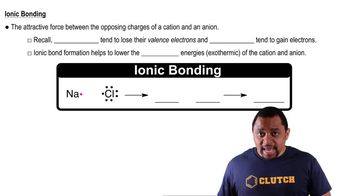
Ionic Bonding

Ionic bonding occurs when electrons are transferred from one atom to another, resulting in the formation of positively charged cations and negatively charged anions. The electrostatic attraction between these oppositely charged ions leads to the formation of ionic compounds like NaCl and KF. This concept is fundamental for understanding the interactions that dictate the distances between ions in a crystal lattice.
Video consigliato: