Ch.8 - Basic Concepts of Chemical Bonding
Brown - Chemistry: The Central Science 15th Edition
Brown15th EditionChemistry: The Central ScienceISBN: 9780137542970Non è quello che usi tu?Cambia libro di testo
Capitolo 8, Problema 4a

The orbital diagram that follows shows the valence electrons for a 3+ ion of an element. (a) What is the element?

Guida verificata passo dopo passo
1
Step 1: Understand the problem. We are given an orbital diagram for a 3+ ion of an element and need to identify the element.
Step 2: Analyze the orbital diagram. Count the number of valence electrons shown in the diagram. Remember, the diagram represents a 3+ ion, meaning the element has lost 3 electrons.
Step 3: Determine the number of electrons in the neutral atom. Add 3 electrons to the number of valence electrons in the diagram to find the total number of electrons in the neutral atom.
Step 4: Identify the element. Use the total number of electrons to find the atomic number of the element, which corresponds to its position on the periodic table.
Step 5: Verify your answer. Ensure that the electron configuration of the neutral atom matches the known configuration for the element you identified.

Risposta video verificata per un problema simile:

Questa soluzione video è stata consigliata dai nostri tutor come utile per risolvere questo problema.
Durata del video:
1m

Concetti chiave

Ecco i concetti essenziali che devi comprendere per rispondere correttamente alla domanda.

Valence Electrons

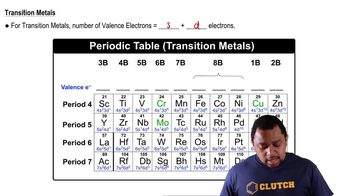
Valence electrons are the outermost electrons of an atom and are crucial in determining how an element reacts chemically. They are involved in forming bonds with other atoms. The number of valence electrons can be inferred from the element's position in the periodic table, particularly for main group elements.
Video consigliato:
Percorso guidato
02:12
Transition Metals Valence Electrons

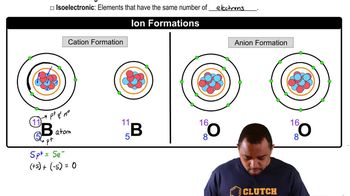
Ion Formation

Ions are charged particles that form when atoms gain or lose electrons. A 3+ ion indicates that the element has lost three electrons, resulting in a positive charge. Understanding how ions form is essential for predicting the behavior of elements in chemical reactions and their stability.
Video consigliato:

Orbital Diagrams

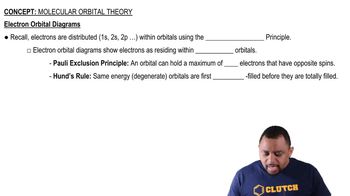
Orbital diagrams visually represent the distribution of electrons in an atom's orbitals. Each box in the diagram corresponds to an orbital, and arrows indicate the presence of electrons. Analyzing these diagrams helps identify the electron configuration of an element, which is key to determining its identity and properties.
Video consigliato:
Percorso guidato
01:16
Electron Orbital Diagrams
Pratica correlata
Domanda del libro di testo

A portion of a two-dimensional 'slab' of NaCl(s) is shown here (see Figure 8.2) in which the ions are numbered. (a) Which colored balls must represent sodium ions?

519
views

Domanda del libro di testo

A portion of a two-dimensional 'slab' of NaCl(s) is shown here (see Figure 8.2) in which the ions are numbered. (d) Consider ion 5. How many repulsive interactions are shown for it?

514
views
Domanda del libro di testo

Which of the following charts shows the general periodic trends for the electronegativities of the representative elements? [Section 8.4]

Domanda del libro di testo

In the Lewis structure shown here, A, D, E, Q, X, and Z represent elements in the first two rows of the periodic table. Identify all six elements so that the formal charges of all atoms are zero.

1295
views
Domanda del libro di testo

A molecule with formula C4H3NO has the connectivity shown in the figure. After the Lewis structure of the molecule is completed, how many of each of the following are there in the molecule:

a. single bonds,

b. double bonds,

c. triple bonds,

d. nonbonding pairs? [Sections 8.3 and 8.5]

1
views
Domanda del libro di testo

Illustrated are four ions — A, B, X, and Y— showing their relative ionic radii. The ions shown in red carry positive charges: a 2+ charge for A and a 1+ charge for B. Ions shown in blue carry negative charges: a 1- charge for X and a 2- charge for Y. (b) Among the combinations in part (a), which leads to the ionic compound having the largest lattice energy?

595
views