
Ch.8 - Basic Concepts of Chemical Bonding
Brown - Chemistry: The Central Science 15th Edition
Brown15th EditionChemistry: The Central ScienceISBN: 9780137542970Non è quello che usi tu?Cambia libro di testo
Capitolo 8, Problema 31

Use data from Appendix C, Figure 7.11, and Figure 7.13 to calculate the lattice energy of KI.

Guida verificata passo dopo passo
1
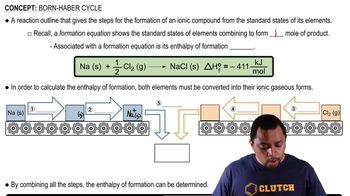
Identify the Born-Haber cycle for KI, which involves the following steps: sublimation of K(s) to K(g), ionization of K(g) to K^+(g), dissociation of I2(g) to 2 I(g), electron affinity of I(g) to I^-(g), and formation of KI(s) from K^+(g) and I^-(g).
Use Appendix C to find the enthalpy of sublimation for K(s) to K(g).
Use Appendix C to find the ionization energy for K(g) to K^+(g).
Use Appendix C to find the bond dissociation energy for I2(g) to 2 I(g), and then calculate the energy for I(g) to I^-(g) using the electron affinity.
Apply Hess's Law to sum the enthalpies of each step in the Born-Haber cycle, including the lattice energy, to solve for the lattice energy of KI.

Risposta video verificata per un problema simile:

Questa soluzione video è stata consigliata dai nostri tutor come utile per risolvere questo problema.
Durata del video:
3m

Concetti chiave

Ecco i concetti essenziali che devi comprendere per rispondere correttamente alla domanda.

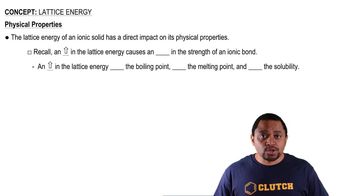
Lattice Energy

Lattice energy is the amount of energy released when gaseous ions combine to form an ionic solid. It is a measure of the strength of the forces between the ions in an ionic compound. Higher lattice energy indicates stronger ionic bonds, which typically results in higher melting points and greater stability of the compound.
Video consigliato:

Born-Haber Cycle

The Born-Haber cycle is a thermodynamic cycle that relates the lattice energy of an ionic compound to other energy changes involved in its formation. It includes steps such as ionization energy, electron affinity, and sublimation energy, allowing for the calculation of lattice energy using Hess's law. This cycle is essential for understanding how different energy contributions affect the overall stability of ionic compounds.
Video consigliato:
Percorso guidato
03:49
Born Haber Cycle

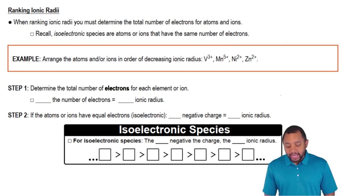
Ionic Radii

Ionic radii refer to the effective size of an ion in a crystal lattice. The size of the ions affects the distance between them, which in turn influences the lattice energy. Smaller ions can pack more closely together, leading to stronger electrostatic attractions and higher lattice energies, while larger ions result in weaker attractions and lower lattice energies.
Video consigliato:
Percorso guidato
03:56
Ranking Ionic Radii