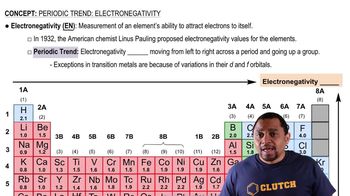
Using only the periodic table as your guide, select the most electronegative atom in each of the following sets: (a) Se, Te, Br, I; (b) Be, Mg, C, Si (c) Al, Si, P, S (d) Zn, Ge, Ga, As.
Ch.8 - Basic Concepts of Chemical Bonding

Brown15th EditionChemistry: The Central ScienceISBN: 9780137542970Non è quello che usi tu?Cambia libro di testo
Capitolo 8, Problema 43
Which of the following bonds are polar: a. B—F, b. Cl—Cl, c. Se—O, d. H—I? Which is the more electronegative atom in each polar bond?
Guida verificata passo dopo passo1
insert step 1> Determine the electronegativity of each atom in the bonds: B, F, Cl, Se, O, H, and I.
insert step 2> Compare the electronegativity values of the atoms in each bond to determine if there is a significant difference.
insert step 3> Identify the bonds with a significant difference in electronegativity as polar bonds.
insert step 4> For each polar bond, identify the atom with the higher electronegativity as the more electronegative atom.
insert step 5> List the polar bonds and the more electronegative atom in each.

Risposta video verificata per un problema simile:
Questa soluzione video è stata consigliata dai nostri tutor come utile per risolvere questo problema.
Durata del video:
4mConcetti chiave
Ecco i concetti essenziali che devi comprendere per rispondere correttamente alla domanda.
Electronegativity
Electronegativity is a measure of an atom's ability to attract and hold onto electrons in a chemical bond. It varies across the periodic table, with elements like fluorine being highly electronegative. In a bond between two different atoms, the atom with higher electronegativity will attract the shared electrons more strongly, leading to a polar bond.
Video consigliato:
Percorso guidato
Electronegativity Trends
Polar Bonds
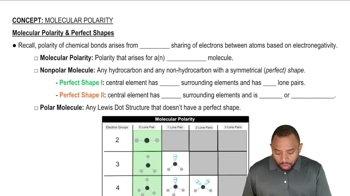
A polar bond occurs when there is a significant difference in electronegativity between the two atoms involved in the bond. This difference causes an uneven distribution of electron density, resulting in a dipole moment where one end of the bond is slightly negative and the other slightly positive. Bonds such as B-F and Se-O are examples of polar bonds due to the differing electronegativities of the atoms.
Video consigliato:
Percorso guidato
Molecular Polarity
Bond Types
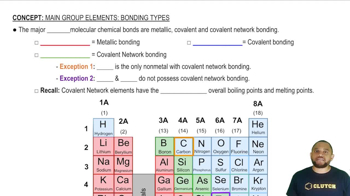
Bonds can be classified as polar or nonpolar based on the electronegativity difference between the bonded atoms. Nonpolar bonds, like Cl-Cl, occur between identical atoms where electron sharing is equal. Understanding the type of bond helps predict molecular behavior, reactivity, and interactions with other molecules, which is crucial in chemistry.
Video consigliato:
Percorso guidato
Bonding Types
Pratica correlata
Domanda del libro di testo
545
views
Domanda del libro di testo
Arrange the bonds in each of the following sets in order of increasing polarity: (c) C—S, B—F, N—O.
697
views
Domanda del libro di testo
(a) From the data in Table 8.2, calculate the effective charges on the H atom of the HBr molecule in units of the electronic charge, e.
2145
views
1
comments
Domanda del libro di testo
Place the following pairs of elements in order from smallest to largest difference in electronegativity: K and F, S and O, Br and I, Ca and Se, Li and Cl.
Domanda del libro di testo
Arrange the bonds in each of the following sets in order of increasing polarity: (a) C—F, O—F, Be—F (b) O—Cl,S—Br, C—P
1222
views
Domanda del libro di testo
By referring only to the periodic table, select (d) the element in the group K, C, Zn, F that is most likely to form an ionic compound with Ba.
591
views