
Ch.9 - Molecular Geometry and Bonding Theories
Brown - Chemistry: The Central Science 15th Edition
Brown15th EditionChemistry: The Central ScienceISBN: 9780137542970Non è quello che usi tu?Cambia libro di testo
Capitolo 9, Problema 108d

Carbon monoxide, CO, is isoelectronic to N2. (d) Would you expect the p2p MOs of CO to have equal atomic orbital contributions from the C and O atoms? If not, which atom would have the greater contribution?

Guida verificata passo dopo passo
1
Understand the term 'isoelectronic': Isoelectronic species have the same number of electrons. Carbon monoxide (CO) and nitrogen (N2) both have 14 electrons, making them isoelectronic.
Consider the atomic structure of CO: Carbon (C) has an atomic number of 6 and oxygen (O) has an atomic number of 8. This means oxygen is more electronegative than carbon.
Analyze the effect of electronegativity on molecular orbitals (MOs): Electronegativity affects the distribution of electrons in molecular orbitals. The more electronegative atom tends to attract more electron density.
Apply the concept to CO: In the case of CO, since oxygen is more electronegative than carbon, the atomic orbitals of oxygen will contribute more to the molecular orbitals, particularly those involving electron density near the oxygen atom.
Conclude on the p2p MOs of CO: Given the higher electronegativity of oxygen, the p2p (pi 2p) molecular orbitals of CO would likely have a greater atomic orbital contribution from the oxygen atom than from the carbon atom.

Risposta video verificata per un problema simile:

Questa soluzione video è stata consigliata dai nostri tutor come utile per risolvere questo problema.
Durata del video:
3m

Concetti chiave

Ecco i concetti essenziali che devi comprendere per rispondere correttamente alla domanda.

Isoelectronic Species

Isoelectronic species are atoms, ions, or molecules that have the same number of electrons and, therefore, the same electronic structure. In this case, carbon monoxide (CO) and nitrogen gas (N2) both have 14 electrons, making them isoelectronic. Understanding this concept helps in predicting similarities in bonding and molecular orbital characteristics between different species.
Video consigliato:
Percorso guidato
03:03
Amphoteric Species

Molecular Orbitals (MOs)

Molecular orbitals are formed by the linear combination of atomic orbitals (LCAO) when atoms bond together. In CO, the p2p molecular orbitals are derived from the p orbitals of carbon and oxygen. The contributions of each atom's atomic orbitals to the molecular orbitals can vary based on their electronegativity and atomic size, influencing the overall bonding characteristics.
Video consigliato:
Percorso guidato
03:06
Molecular Orbital Theory

Electronegativity and Atomic Size

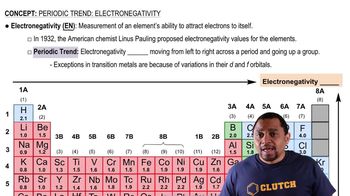
Electronegativity is a measure of an atom's ability to attract and hold onto electrons, while atomic size refers to the distance from the nucleus to the outermost electrons. In CO, oxygen is more electronegative than carbon, which means that the p2p molecular orbitals will have a greater contribution from the oxygen atom. This difference affects the distribution of electron density and the overall stability of the molecule.
Video consigliato:
Percorso guidato
02:10
Electronegativity Trends
Pratica correlata
Domanda del libro di testo

The energy-level diagram in Figure 9.40 shows that the sideways overlap of a pair of p orbitals produces two molecular orbitals, one bonding and one antibonding. In ethylene there is a pair of electrons in the bonding orbital between the two carbons. Absorption of a photon of the appropriate wavelength can result in promotion of one of the bonding electrons from the to the molecular orbital. b. Assuming this electronic transition corresponds to the HOMO–LUMO transition, what is the LUMO in ethylene?

3
views
Domanda del libro di testo

Azo dyes are organic dyes that are used for many applications, such as the coloring of fabrics. Many azo dyes are derivatives of the organic substance azobenzene, C12H10N2. A closely related substance is hydrazobenzene, C12H12N2. The Lewis structures of these two substances are

(Recall the shorthand notation used for benzene.) (b) How many unhybridized atomic orbitals are there on the N and the C atoms in each of the substances? How many unhybridized atomic orbitals are there on the N and the C atoms in hydrazobenzene?

674
views
Domanda del libro di testo

The energy-level diagram in Figure 9.40 shows that the sideways overlap of a pair of p orbitals produces two molecular orbitals, one bonding and one antibonding. In ethylene there is a pair of electrons in the bonding orbital between the two carbons. Absorption of a photon of the appropriate wavelength can result in promotion of one of the bonding electrons from the to the molecular orbital. c. Is the bond in ethylene stronger or weaker in the excited state than in the ground state? Why?

2
views
Domanda del libro di testo

Azo dyes are organic dyes that are used for many applications, such as the coloring of fabrics. Many azo dyes are derivatives of the organic substance azobenzene, C12H10N2. A closely related substance is hydrazobenzene, C12H12N2. The Lewis structures of these two substances are

(Recall the shorthand notation used for benzene.) (c) Predict the N¬N¬C angles in each of the substances.

513
views
Domanda del libro di testo

Place the following molecules and ions in order from smallest to largest bond order: H2+,B2,N2+,F2+, and Ne2.

2
views
Domanda del libro di testo

The energy-level diagram in Figure 9.40 shows that the sideways overlap of a pair of p orbitals produces two molecular orbitals, one bonding and one antibonding. In ethylene there is a pair of electrons in the bonding orbital between the two carbons. Absorption of a photon of the appropriate wavelength can result in promotion of one of the bonding electrons from the to the molecular orbital. a. Assuming this electronic transition corresponds to the HOMO–LUMO transition, what is the HOMO in ethylene?

4
views