Consider the following XF4 ions: PF4-, BrF4-, ClF4+, and AlF4-. (c) Which of the ions will have an octahedral electron-domain geometry?
Ch.9 - Molecular Geometry and Bonding Theories

Brown15th EditionChemistry: The Central ScienceISBN: 9780137542970Non è quello che usi tu?Cambia libro di testo
Capitolo 9, Problema 33a
Consider the following XF4 ions: PF4-, BrF4-, ClF4+, and AlF4-. (a) Which of the ions have more than an octet of electrons around the central atom?
Guida verificata passo dopo passo1
Determine the number of valence electrons for each central atom: P, Br, Cl, and Al.
Add or subtract electrons based on the charge of the ion: add one electron for negative charges and subtract one for positive charges.
Calculate the total number of electrons around the central atom by adding the electrons from the fluorine atoms (each F contributes one electron to the central atom).
Check if the total number of electrons around the central atom exceeds 8, which would indicate more than an octet.
Identify which ions have central atoms with more than 8 electrons, indicating an expanded octet.

Risposta video verificata per un problema simile:
Questa soluzione video è stata consigliata dai nostri tutor come utile per risolvere questo problema.
Durata del video:
16mConcetti chiave
Ecco i concetti essenziali che devi comprendere per rispondere correttamente alla domanda.
Octet Rule
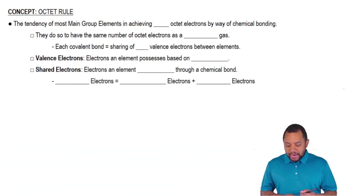
The octet rule is a chemical principle that states atoms tend to bond in such a way that they have eight electrons in their valence shell, achieving a stable electron configuration similar to that of noble gases. This rule is particularly relevant for main group elements, which typically form bonds to fulfill this requirement. However, some elements, especially those in the third period and beyond, can expand their octet due to available d-orbitals.
Video consigliato:
Percorso guidato
Octet Rule
Expanded Octet
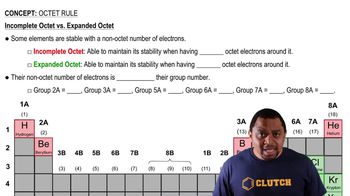
An expanded octet occurs when an atom has more than eight electrons in its valence shell. This phenomenon is common in elements from the third period of the periodic table and beyond, such as phosphorus, sulfur, and chlorine, which can utilize their d-orbitals to accommodate additional electrons. Understanding which elements can expand their octet is crucial for predicting the bonding and structure of certain molecules and ions.
Video consigliato:
Percorso guidato
Octet Rule
Lewis Structures
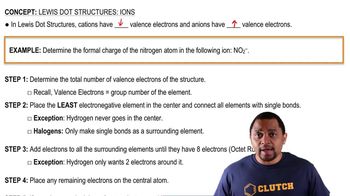
Lewis structures are diagrams that represent the bonding between atoms in a molecule and the lone pairs of electrons that may exist. They are essential for visualizing the arrangement of electrons and determining whether an atom has achieved an octet or an expanded octet. By drawing Lewis structures for the given ions, one can easily identify the number of electrons surrounding the central atom and assess compliance with the octet rule.
Video consigliato:
Percorso guidato
Lewis Dot Structures: Ions
Pratica correlata
Domanda del libro di testo
1139
views
Domanda del libro di testo
Give the approximate values for the indicated bond angles in the following molecules: (d)
1408
views
Domanda del libro di testo
Ammonia, NH3, reacts with incredibly strong bases to produce the amide ion, NH2-. Ammonia can also react with acids to produce the ammonium ion, NH4+. (a) Which species (amide ion, ammonia, or ammonium ion) has the largest H¬N¬H bond angle? (b) Which species has the smallest H¬N¬H bond angle?
1045
views
Domanda del libro di testo
Which of the following statements are true?
i. The overall dipole moment of a molecule is the vector sum of its individual bond dipoles.
ii. If atoms A and B in an AB𝑛 molecule have different electronegativities, then the AB𝑛 molecule must have a nonzero dipole moment.
iii. The bond dipoles in a tetrahedral AB4 molecule cancel one another.